
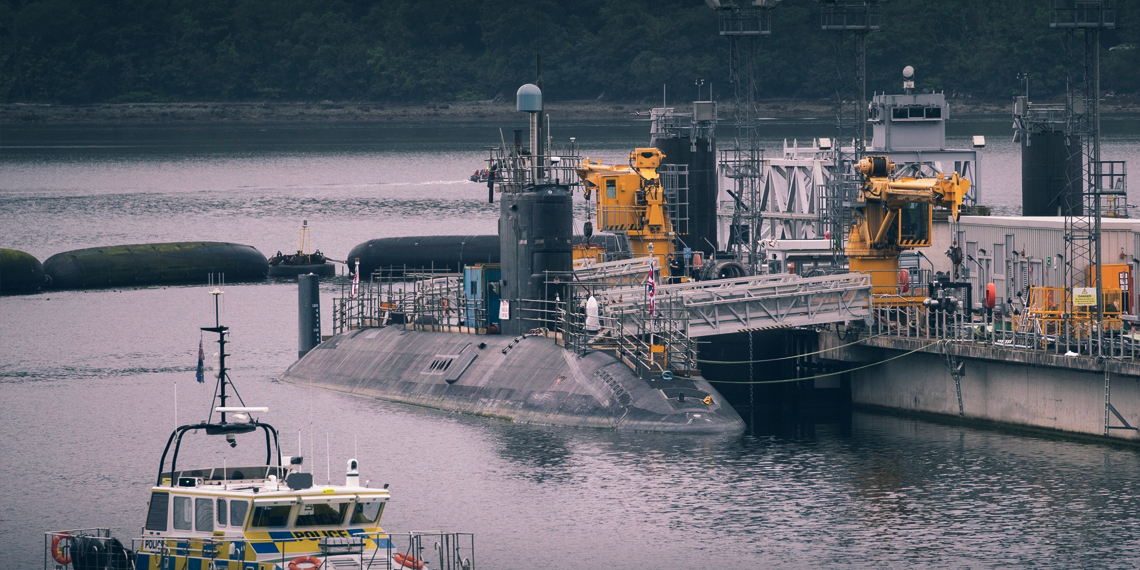
A Faslane nuclear submarine base security breach investigation is underway after police in Scotland charged two individuals accused of attempting to gain unauthorised access to one of the UK’s most sensitive military installations.
Police Scotland confirmed that a 34-year-old Iranian man and a 31-year-old Romanian woman were arrested following reports of suspicious activity near HM Naval Base Clyde, commonly known as Faslane, located on Scotland’s west coast.
The Faslane nuclear submarine base security breach incident has raised fresh questions about the protection of critical defence infrastructure, as authorities continue to examine the circumstances surrounding the attempted entry.
Arrests follow attempted access to high-security site
According to Police Scotland, officers were alerted to the situation at approximately 5pm on Thursday, after receiving reports that individuals were attempting to enter the base.
The suspects were arrested the following day and have since been formally charged. They are scheduled to appear at Dumbarton Sheriff Court on Monday.
Police said enquiries into the incident remain ongoing, with investigators working to determine the motives behind the attempted breach.
Royal Navy confirms incident at Faslane
A spokesperson for the Royal Navy confirmed that two individuals had attempted to enter the base but were unsuccessful.
The spokesperson added that the matter is now subject to an active investigation and declined to provide further details.
The incident has drawn attention due to the strategic importance of Faslane, which plays a central role in the UK’s national defence capabilities.
Faslane’s role in UK nuclear deterrence
HM Naval Base Clyde at Faslane is widely regarded as one of the most critical military facilities in the United Kingdom.
The base is home to:
•The UK’s Trident nuclear deterrent
•The core of the Royal Navy’s attack submarine fleet
•Thousands of military personnel and civilian staff
Security experts describe Faslane as the backbone of Britain’s continuous at-sea nuclear deterrence, ensuring the country maintains a permanent nuclear capability.
Security concerns around critical infrastructure
The Faslane nuclear submarine base security breach attempt highlights the ongoing challenges in safeguarding high-value military assets.
Defence analysts have long warned that such facilities are potential targets for espionage, sabotage, or other hostile activities.
Michael Clarke, a defence and security analyst, described Faslane as “probably Britain’s most important single installation”.
He noted that the base supports the operational deployment of the UK’s submarine fleet, including vessels responsible for national defence missions.
Scale and importance of the Faslane base
Faslane is the largest military base in Scotland, employing an estimated 6,000 to 7,000 personnel, including both military staff and civilians.
It serves as the primary operating hub for the UK’s fleet of nuclear-powered submarines, which are essential for maintaining strategic deterrence.
The base’s location on the Gare Loch provides direct access to deep waters, making it ideal for submarine operations.
Ongoing investigation into motives
Authorities have not yet disclosed details regarding the suspects’ intentions or whether the incident poses a broader security threat.
The Faslane nuclear submarine base security breach case is expected to involve coordination between police, military authorities and national security agencies.
Investigators will likely assess whether the attempt was isolated or linked to wider concerns.
UK nuclear security and global tensions
The incident comes at a time of heightened global tensions, with increased focus on the protection of critical infrastructure.
The UK’s nuclear deterrent, based at Faslane since the 1960s, is a cornerstone of national security policy and a key component of NATO’s defence strategy.
Recent geopolitical developments have underscored the importance of securing military installations against potential threats.
Broader implications for national security
The Faslane nuclear submarine base security breach raises broader questions about resilience and preparedness in protecting strategic assets.
While the attempted entry was unsuccessful, the incident may prompt reviews of security protocols and surveillance measures at sensitive sites.
Government and defence officials are likely to examine whether additional safeguards are needed to address evolving risks.
Court proceedings and next steps
The two suspects are due to face legal proceedings at Dumbarton Sheriff Court, where further details about the case may emerge.
Police Scotland has indicated that investigations are continuing, suggesting that more information could be released in the coming days.
As the case develops, attention will remain focused on ensuring the integrity and security of one of the UK’s most vital defence installations.