
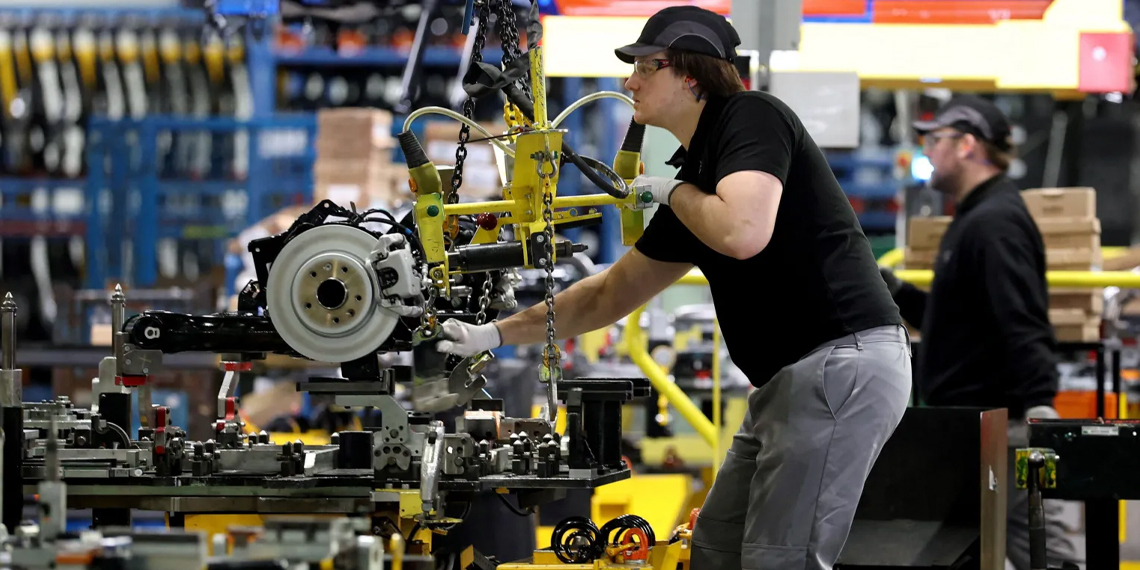
Japanese car manufacturer Nissan has announced plans to merge production lines at its Sunderland plant in the UK while cutting around 900 jobs across Europe as part of a wider restructuring programme.
The company said the changes are part of its “RE:Nissan” recovery strategy aimed at creating a leaner and more flexible business capable of adapting to changing market conditions.
Sunderland Plant to Consolidate Production Lines
Nissan confirmed it will combine two production lines at its Sunderland factory, where the company builds models including the Leaf, Juke and Qashqai.
Although one production line will be closed, the company said the move will not result in direct job losses at the plant.
The restructuring is designed to improve efficiency and free up unused capacity within the factory, which has been operating below its full production potential.
European Workforce Reduction Planned
Alongside the UK changes, Nissan is planning to reduce approximately 10% of its European workforce.
The job cuts will include roles linked to warehouse operations in Barcelona as well as administrative positions across the region, including a small number in the UK.
Company officials said discussions with employees and unions are ongoing as part of the restructuring process.
Recovery Plan Targets Long-Term Stability
Nissan said the measures are intended to improve profitability and ensure long-term sustainability in an increasingly competitive automotive market.
The company stated that simplifying operations and reducing costs are key priorities as global car manufacturers face rising pressures linked to electrification, supply chains and slowing demand in some markets.
Executives described the restructuring as necessary to create a more resilient business model.
Potential Opportunities for New Manufacturers
The closure of one production line at Sunderland could create opportunities for another automaker to use the available capacity.
Industry reports suggest Nissan has held discussions with several companies, including Chinese automotive giant Chery, which owns the Jaecoo and Omoda brands.
Chery has expanded rapidly in the UK market and is already preparing vehicle assembly operations at a former Nissan site in Barcelona.
UK Automotive Industry Faces Growing Challenges
The announcement comes amid wider uncertainty across the UK automotive sector, which continues to deal with economic pressures, global competition and the transition to electric vehicles.
Manufacturers have also faced challenges linked to supply chain disruptions, higher energy costs and post-Brexit trade conditions.
Despite these pressures, Sunderland remains one of the UK’s largest car manufacturing hubs and a major employer in the region.
Shift Toward Electric Vehicle Production
Nissan has invested heavily in electric vehicle development, with Sunderland playing a central role in the company’s long-term EV strategy.
The plant has previously been identified as a key site for future battery and electric vehicle production in Europe.
Analysts say restructuring efforts may help Nissan position itself more competitively as the global automotive industry accelerates its shift toward low-emission transport.
Restructuring Across Global Car Industry
Major car manufacturers worldwide have announced cost-cutting and restructuring measures in recent years as the industry adapts to changing consumer demand and stricter environmental regulations.
European plants in particular have faced pressure to improve efficiency while competing with lower-cost production bases and growing Chinese manufacturers.
Nissan’s latest moves reflect broader trends reshaping the global automotive market, with companies increasingly seeking partnerships, streamlined operations and new production models to remain competitive.