
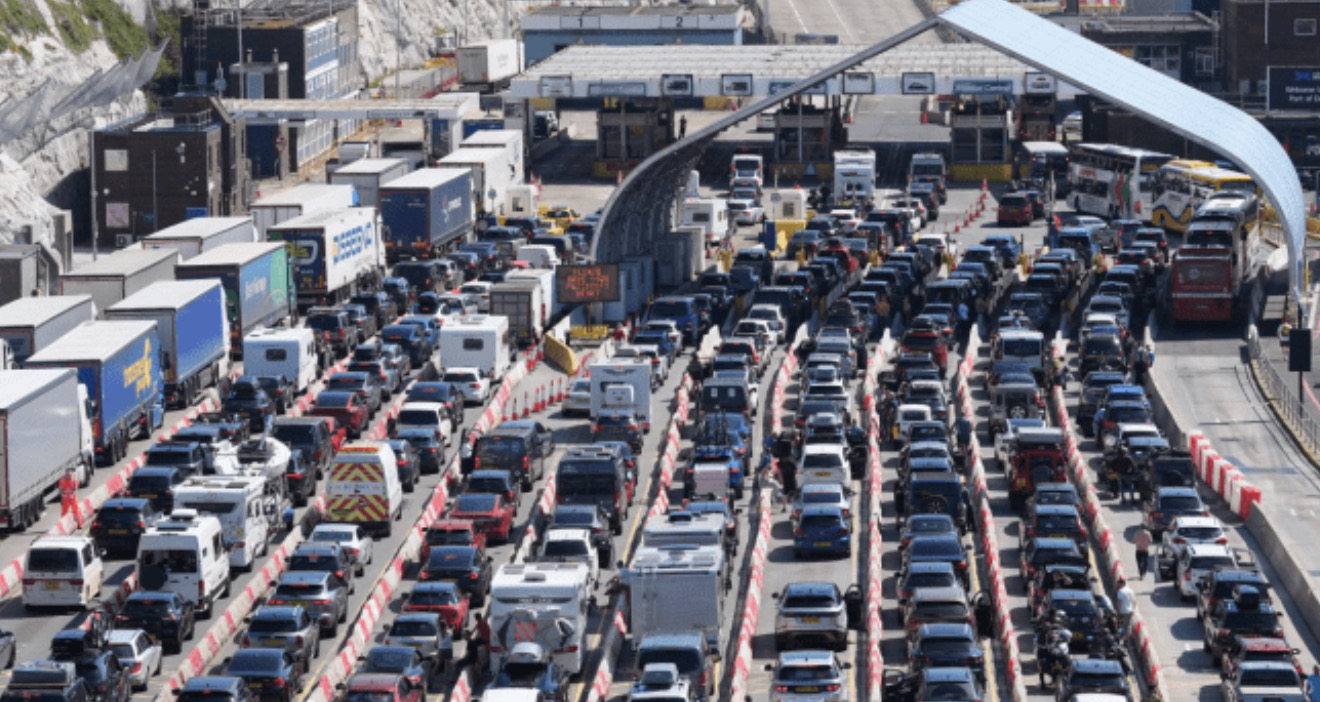
Thousands of drivers travelling through the Port of Dover faced delays of more than three hours during the bank holiday getaway as French authorities temporarily suspended new EU border checks to ease severe congestion.
More than 18,000 travellers were expected to pass through the Kent port across Friday and Saturday, with queues building rapidly in sweltering heat approaching 30°C.
Long delays were reported for all ferry operators and across tourist traffic check-in areas as heavy holiday traffic caused major disruption around Dover.
By Saturday lunchtime, processing times inside the port’s buffer zone had fallen to around 50 minutes, but congestion on surrounding roads still left motorists facing waits of nearly three hours before reaching ferries.
In response to the growing queues, French border police suspended the EU’s new Entry and Exit System (EES) checks at Dover.
The decision was taken by Police Aux Frontieres (PAF) using an emergency clause designed to reduce pressure at busy border crossings.
In a statement posted on X, the Port of Dover said: “We are pleased that Police Aux Frontieres (PAF) have responded positively by invoking the Article 9 clause of the EES regulations.”
“While conventional border checks will still be undertaken, this will now enable PAF to significantly reduce the border processing time.”
The temporary suspension means travellers crossing into France will not currently need to provide fingerprints or facial biometric data as part of the EU’s new border system.
At Dover and the Le Shuttle terminal in Folkestone, travellers normally complete French border checks before crossing the English Channel.
Under the EES system, non-EU nationals are required to register biometric details during their first entry into the Schengen area.
However, unlike many European airports, self-service registration machines have not yet been introduced at UK ports.
Travel expert Simon Calder said French border officers had initially attempted to process passengers manually using 11 checkpoints before reverting to traditional passport stamping to speed up traffic flow.
The delays come during one of the busiest travel weekends of the year, with around 3.4 million journeys expected across the UK on Sunday and another 3.1 million on bank holiday Monday.
According to the RAC, major congestion is also expected on routes including the M1, M25, M5 and M6 motorways.
The motoring group warned some journeys on the M25 could take twice as long as normal due to heavy traffic volumes.
Despite rising fuel prices linked to disruption in global oil markets following tensions around the Strait of Hormuz, the RAC said only a small proportion of drivers had cancelled leisure travel plans.