
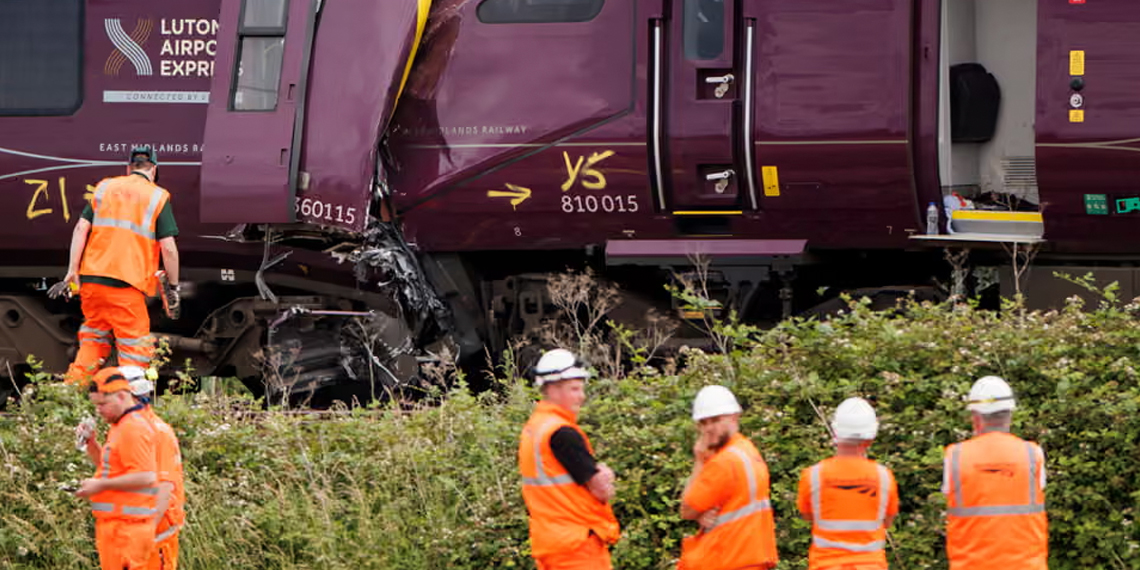
Rail passengers travelling between Bedford and London are facing significant disruption for at least another week after a fatal train collision near Bedford claimed the life of a train driver and left around 100 people injured. Network Rail has confirmed that the Bedford-Luton section of the Midland Main Line will remain closed while emergency recovery operations and safety investigations continue, with engineers working around the clock to restore one of the UK’s busiest commuter routes.
The fatal collision, which involved two East Midlands Railway (EMR) services travelling towards London St Pancras, has prompted a large-scale emergency response and a complex recovery operation that officials say will require several days to complete. Authorities have described the incident as a tragic but isolated event, while urging the public to avoid speculation as investigators work to establish the exact sequence of events.
According to Network Rail, services between Bedford and Luton will remain suspended for the remainder of the week, with replacement bus services operating on a limited basis. Passengers travelling to and from London are expected to experience considerable delays and altered routes, while direct rail services between Bedford and London St Pancras will remain unavailable.
Beginning Monday, a reduced Thameslink service will operate between London St Pancras and Luton. However, trains will not continue north of Luton, leaving commuters across Bedfordshire and surrounding areas dependent on alternative transport arrangements.
In addition, Luton Airport Express services have been cancelled, with replacement buses operating between Luton Airport and Luton station to maintain connectivity for travellers.
Network Rail explained that the extensive disruption is necessary to facilitate one of the most technically demanding railway recovery operations undertaken in recent years. Engineers are currently removing overhead electrical lines and constructing a temporary access road to the crash site, enabling heavy recovery equipment to reach the damaged trains.
The recovery effort will involve two 110-tonne cranes tasked with lifting the severely damaged locomotives and carriages onto trailers for removal by road. Once the trains have been cleared, engineers will conduct detailed inspections of the railway infrastructure to assess any damage to the tracks, signalling systems, and electrical equipment before repairs can begin.
Ellie Burrows, Managing Director of Network Rail’s Eastern Region, acknowledged the scale of the operation and emphasized that specialist teams are working continuously to reopen the railway as quickly and safely as possible.
She described the collision as a “tragic isolated incident” based on current evidence while stressing that the recovery process is both complex and highly challenging.
Burrows also advised passengers to expect significant travel disruption throughout most of the coming week and urged people to travel only if absolutely necessary until normal services can safely resume.
The human impact of the accident remains considerable. Emergency services responded rapidly on Friday afternoon following the collision, treating dozens of injured passengers at the scene before transferring many to nearby hospitals.
More than 80 passengers required hospital treatment following the crash, while official updates confirmed that 28 individuals remained hospitalized as of Saturday morning. Nine of those injured continue to be listed in critical condition, highlighting the severity of the incident.
The collision involved the 4:40 pm East Midlands Railway service travelling from Corby to London St Pancras and the 3:50 pm Nottingham to London St Pancras service. Preliminary information indicates that the Corby train collided with the rear of the Nottingham service, crushing the front section of one train while causing additional damage as several carriages were forced into one another.
The Rail Accident Investigation Branch (RAIB) has launched a full independent safety investigation into the crash. Investigators remain on site gathering evidence from the railway infrastructure, damaged rolling stock, and operational systems near Elstow, just south of the A421 and A6 interchange.
The agency has stated that it will conduct a comprehensive examination of every aspect of the incident before issuing its findings and recommendations aimed at improving railway safety.
British Transport Police officers and specialist investigators are working alongside RAIB officials throughout the investigation. Authorities have appealed to the public and social media users to refrain from speculation until verified information becomes available through official channels.
While investigators continue their work, local residents have been praised for their remarkable response in the immediate aftermath of the accident. British Transport Police Chief Constable Lucy D’Orsi commended the Bedfordshire community for demonstrating extraordinary compassion toward stranded passengers and emergency responders.
Residents living near the crash site reportedly provided food, drinking water, and practical assistance to passengers trapped aboard damaged trains while emergency services worked to reach them.
One local resident described witnessing neighbours gathering supplies and passing refreshments through fences to help frightened and injured passengers awaiting rescue, illustrating the community spirit that emerged during the crisis.
To minimize disruption, Network Rail has confirmed that East Midlands Railway tickets will be accepted on alternative routes operated by other train companies where possible. Passengers who postpone their journeys until the railway reopens will also be able to use connecting tickets on partner operators on the day they travel.
Travel planners and digital journey applications are being updated regularly to reflect timetable changes, replacement bus services, and revised connections. However, officials warn that updates may take time to appear across all platforms and advise passengers to check live travel information before leaving home.
As recovery operations continue and investigators work to determine the cause of one of the most serious rail incidents in recent years, the priority remains restoring safe services while supporting those affected by the tragedy. For thousands of commuters, travellers, and families across Bedfordshire and beyond, the coming days will continue to bring significant disruption as Britain’s railway network recovers from a devastating accident.