
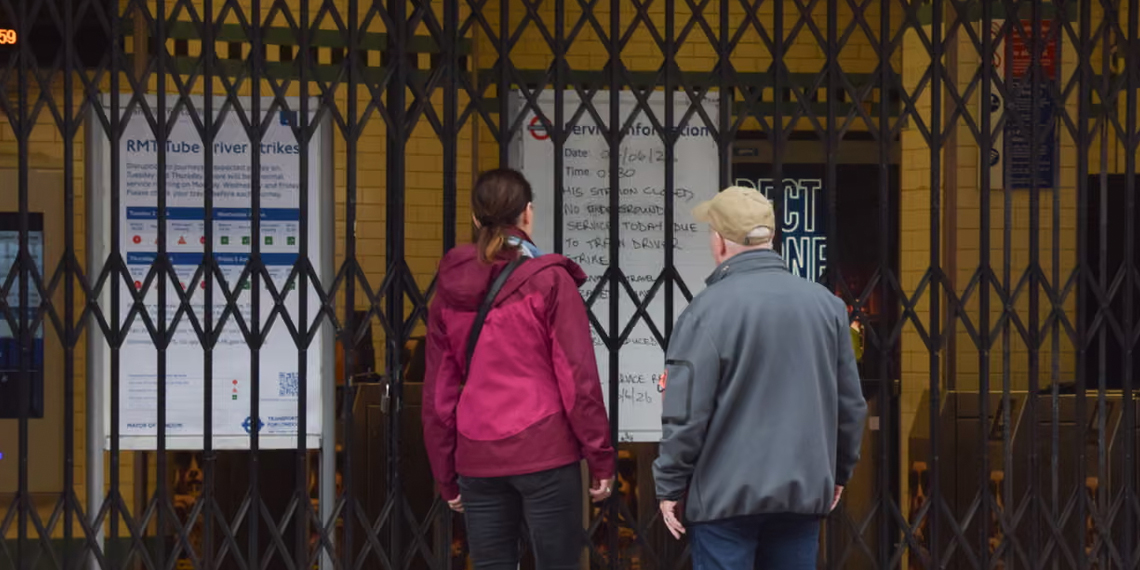
London commuters are facing a second day of disruption this week as a 24-hour strike by London Underground drivers affects services across the capital.
The industrial action, organised by the National Union of Rail, Maritime and Transport Workers, began on Thursday amid an ongoing dispute with Transport for London over plans to introduce a four-day working week for Tube drivers.
Several Underground routes have been severely affected, with no service expected on the Circle and Piccadilly lines, as well as central sections of the Metropolitan and Central lines.
Other lines are operating reduced timetables, with later starts, earlier finishes and fewer trains than normal.
On Thursday morning, TfL reported severe delays on the District, Bakerloo and Northern lines, while several other routes experienced minor disruptions.
Passengers have been urged to check travel updates before setting off, although alternative transport services including the Elizabeth line, London Overground, National Rail services and the Docklands Light Railway are operating as normal.
Buses are also running, but TfL warned they are likely to be significantly busier due to increased demand.
Despite fears of widespread disruption, Tuesday’s strike had less impact than expected after more drivers than anticipated reported for work.
TfL said around 60% of Tube drivers worked during the first strike day, suggesting some RMT members chose not to participate in the industrial action.
The dispute centres on proposals for a voluntary four-day working week, a plan strongly supported by the Associated Society of Locomotive Engineers and Firemen, which represents slightly more than half of London Underground drivers.
The RMT, however, argues that the proposals could lead to unwanted changes to working arrangements and has accused TfL of attempting to push through reforms without sufficient guarantees.
TfL maintains that the scheme is entirely voluntary.
A TfL spokesperson said: “We are grateful to our customers for their patience while they made their journeys on Tuesday in spite of the disruption on our network caused by the RMT’s industrial action.”
“Oyster and contactless card taps were only down by around 10% across the whole day, showing that Londoners and visitors to the city were still able to travel despite the strike action.”
According to TfL data, Tube journeys fell by 41% during Tuesday’s strike, while passenger numbers rose sharply on buses, the Overground and the Elizabeth line.
The spokesperson added: “We managed to run services on most lines, with the Jubilee line in particular running almost 90% of normally scheduled kilometres. We continue to urge the RMT to work with us to resolve their questions on the proposed four-day week.”
No further strike dates have been announced, although discussions between TfL and the union are expected to resume next week.
