
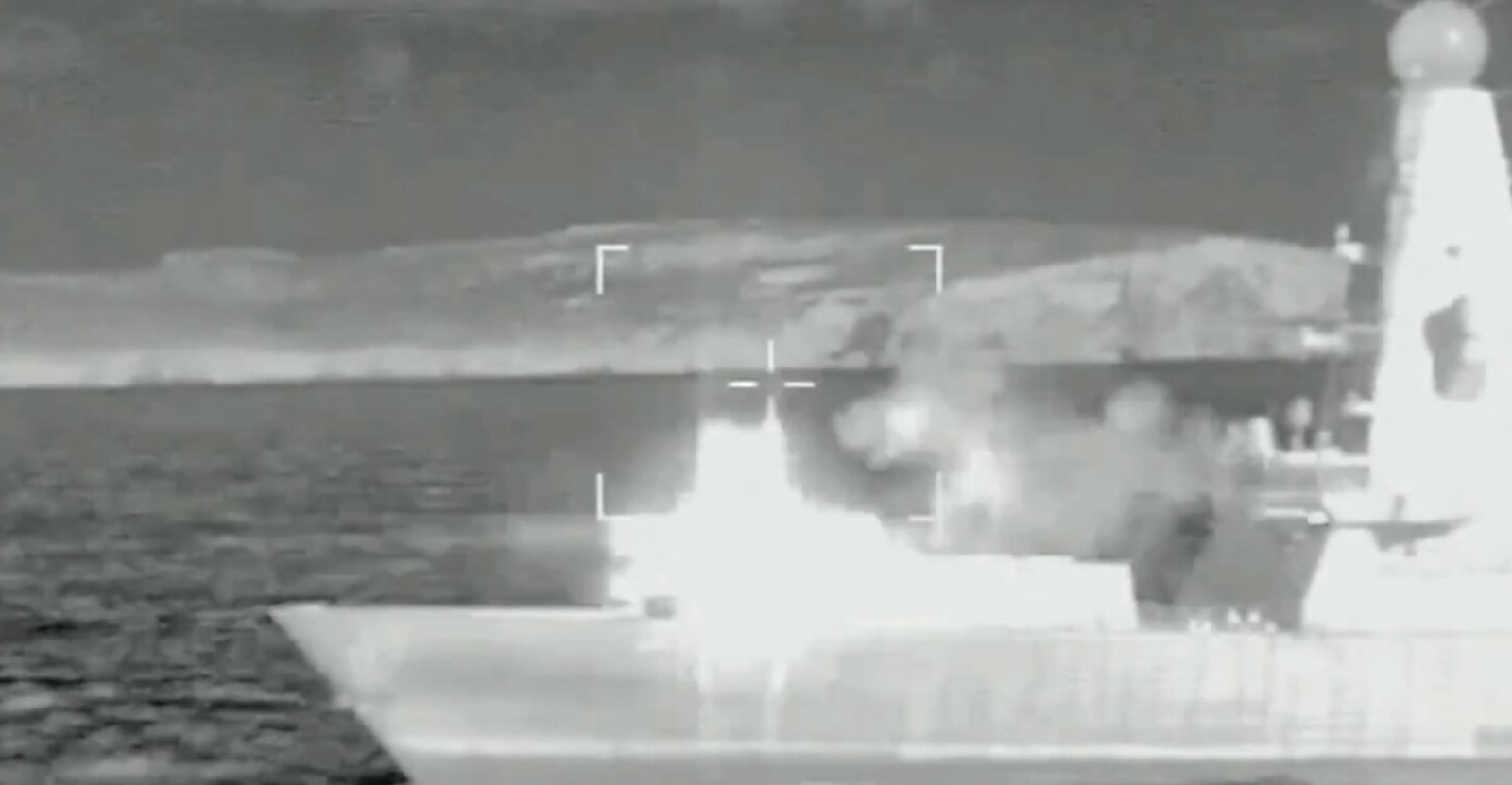
A British warship has successfully intercepted swarms of attack drones during a high-intensity training exercise designed to simulate modern battlefield threats.
The HMS Duncan, a Royal Navy destroyer based in Portsmouth, took part in a 72-hour operation off the Welsh coast as part of Exercise Sharpshooter at the Aberporth Range in Cardigan Bay.
The exercise placed the warship under sustained pressure with multiple simulated attacks, including aerial and surface drones travelling at speeds exceeding 200mph.
The scenario also included mock cruise and ballistic missile threats, reflecting the increasingly complex security challenges faced by modern naval forces.
The training environment was designed to replicate real-world conditions, including those encountered by HMS Diamond in the Red Sea in 2024, when Houthi forces launched drones and missiles against merchant vessels.
During the exercise, HMS Duncan used a wide range of defensive systems to detect and neutralise the incoming threats.
Weapons deployed included Martlet missiles, heavy machine guns, the Phalanx automated close-in defence system, a 30mm cannon and the ship’s 4.5-inch naval gun. The crew also conducted simulated engagements using the Sea Viper air defence system.
The destroyer was supported by a Wildcat helicopter from 815 Naval Air Squadron, which helped track and respond to threats.
Commander Dan Lee, commanding officer of HMS Duncan, said the exercise tested both technology and personnel.
“Sharpshooter was an invaluable opportunity to test our systems and our people in a demanding environment. The ship’s company rose to every challenge, delivering successful layered-defence engagements while simultaneously dealing with realistic damage-control scenarios.”
“I am immensely proud of how the team performed; their dedication ensures that HMS Duncan remains ready to fight and ready to protect.”
Exercise Sharpshooter also involved the use of advanced uncrewed systems to simulate hostile attacks.
These included the Hammerhead uncrewed surface vessel, capable of travelling at speeds of up to 50mph, and the Banshee Whirlwind aerial drone developed by QinetiQ.
Simulated ships and aircraft were also included to replicate complex naval operations.
Petty Officer James Ings, who maintains the ship’s 4.5-inch gun, said the exercise gave crews valuable experience.
“It was a good week for the gun. We put more than 200 rounds down it and did some proper naval gunfire support as well.”
“The 30mm medium calibre gun threw up a few faults, but that’s engineering – you figure it out and you get it working again.”
The exercise was organised by the Royal Navy’s Fleet Operational Standards and Training teams in collaboration with QinetiQ and Inzpire.
Will Blamey, chief executive of UK Defence at QinetiQ, said the training prepares armed forces for evolving threats.
“We are proud to deliver dynamic, real-life scenarios that best-prepare our armed forces for the complex warfare challenges of today and tomorrow.”
“Our combination of live and synthetic threats mean we can evolve training scenarios to ensure we are providing the very latest in threat representation.”
The exercise highlights the growing importance of drone defence capabilities as modern warfare increasingly involves unmanned aerial and surface systems.