
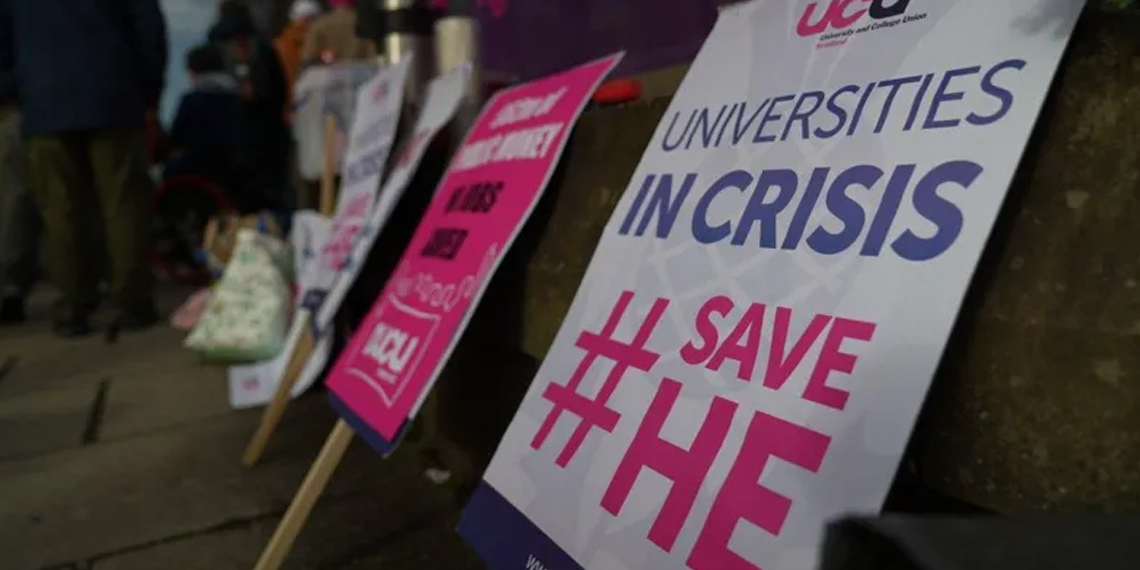
A Heriot-Watt University strike has been announced as lecturers prepare to walk out in protest against job cuts and course closures, highlighting growing financial pressures across Scotland’s higher education sector.
Academics at Heriot-Watt University in Edinburgh are set to take industrial action over plans to cut 41 jobs at its Riccarton campus and a further 10 positions at its Malaysia campus, sparking concerns over the future of academic programmes and staff wellbeing.
Union leaders say the dispute reflects a wider crisis in UK universities, driven by funding challenges, rising costs and declining international student numbers.
Lecturers Strike Over Job Cuts and Course Closures
The strike action has been organised by the University and Colleges Union (UCU), which warned that job losses across the country are reaching critical levels.
At Heriot-Watt, proposed cuts are expected to significantly impact the department of languages and intercultural studies, potentially ending undergraduate teaching in German and Chinese. Staff reductions are also planned for the Scholar online learning programme for school pupils.
Kate Sang, president of the university’s UCU branch, said the institution has not ruled out compulsory redundancies, adding that students are already seeing reduced course options and withdrawn offers.
She described the situation as unprecedented in her 14 years with the union, noting high levels of distress among staff.
“I’ve never seen people so affected — many are struggling to cope with the uncertainty,” she said.
Staff Describe Uncertainty and Growing Pressure
Academic staff have voiced concerns about job security and the impact on teaching quality. Matt Riemland, an assistant professor in German, said his future at Heriot-Watt University remains uncertain after relocating to Scotland less than a year ago.
“It’s extremely distressing for many of us,” he said. “It’s hard to focus on delivering the best for students when our jobs are at risk.”
The university reported a £7.9m deficit for the 2024/25 financial year, citing rising operational costs but maintaining that restructuring is necessary to ensure long-term sustainability.
In response, a university spokesperson acknowledged the difficulty of the situation but emphasised a preference for voluntary severance over compulsory redundancies. They also described the timing of the strike as “disappointing” given ongoing negotiations with union representatives.
Government Urges Dialogue but Faces Pressure to Act
Scotland’s universities minister Ben McPherson has urged both sides to continue negotiations, stating that while the Scottish government cannot directly intervene, it encourages constructive dialogue.
However, the UCU has called for stronger government involvement, arguing that systemic underfunding is driving institutions toward cuts that threaten both jobs and educational quality.
UCU general secretary Jo Grady said the scale of the crisis is unprecedented, with more jobs at risk than ever before.
“We need full funding for universities and guarantees against compulsory redundancies,” she said, adding that ongoing reviews offer little reassurance to those currently facing job losses.
Wave of Strikes Across Scotland Universities
The dispute at Heriot-Watt University is part of a broader wave of industrial action across Scotland’s higher education sector.
Staff at University of Strathclyde, University of Aberdeen and University of Dundee have also taken strike action over job cuts and redundancy concerns.
Strathclyde plans to cut 76 roles, while Dundee aims to reduce the equivalent of 180 full-time positions. Aberdeen is implementing job cuts to achieve savings of more than £5m.
Further disruption is expected, with strikes due to resume at the University of Edinburgh and a ballot opening at Glasgow Caledonian University, where up to 100 roles could be at risk due to a £10m funding gap.
More than half of Scotland’s universities have been involved in disputes over staffing or funding cuts within the past year, reflecting widespread instability in the sector.
Financial Pressures Behind the Higher Education Crisis
Sector leaders point to a combination of rising costs and unstable income streams as key drivers of the crisis. Claire McPherson, director of Universities Scotland, said institutions are facing “an incredibly challenging mix” of financial pressures.
Inflation, energy costs and increases in national insurance contributions have all added to operational expenses, while income from international students — a crucial revenue source — has declined over the past two years.
Universities in Scotland also face structural funding challenges linked to the government’s policy of free tuition for Scottish students. Institutions argue that public funding has not kept pace with inflation and is significantly lower per student compared to tuition fee income in England.
To offset this gap, universities have relied heavily on international students, who can pay up to £40,000 per year in tuition fees. However, changes to immigration policies, currency fluctuations and growing global competition have made this revenue stream increasingly unpredictable.
Sustainability Review and Future of Scottish Universities
The Scottish government has launched a review into the long-term financial sustainability of higher education, aiming to address systemic issues affecting universities across the country. The review is expected to report after the next Scottish parliamentary election.
The findings are likely to shape future funding models and policy decisions, including how universities balance accessibility, quality and financial viability.
The situation at Heriot-Watt University illustrates the broader challenges facing the sector, where institutions must navigate financial constraints while maintaining academic standards and protecting staff.
As strikes escalate and job cuts continue, the outcome of ongoing negotiations — and the government’s response — will be critical in determining the future direction of Scotland’s higher education system.