
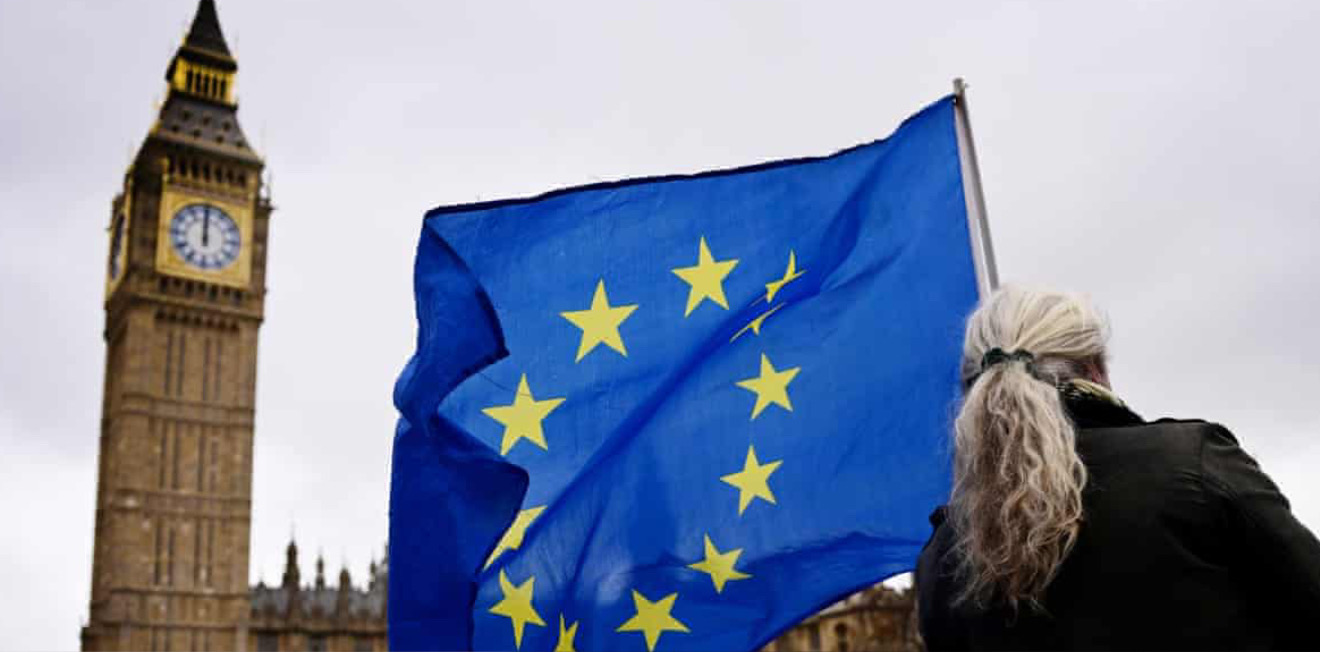
Support for the UK rejoining the European Union is gaining momentum, with more than half of British voters now backing a full return, according to new research published 10 years after the Brexit referendum.
The study by Best for Britain found that 53% of voters support rejoining the EU, with particularly strong backing among Labour, Liberal Democrat and Green party supporters.
The findings highlight a shift in public opinion, with more voters now favouring full EU membership over partial arrangements such as rejoining the single market or customs union.
Support among Labour voters stands at 83%, rising to 84% for Liberal Democrats and 82% for Green voters. Even among Conservative and Reform voters, 39% and 18% respectively said they would support rejoining.
Despite this, 61% of voters said they support the government’s current approach to EU relations — although only 19% expressed strong backing.
Experts warn that Labour’s cautious approach could cost the party support among pro-European voters.
Tom Brufatto said: “We think that there is inherent risk with halfway houses.”
Researchers examined several post-Brexit scenarios, including maintaining current arrangements, diverging further from EU rules, or moving towards closer integration.
However, rejoining structures like the single market or customs union remains politically sensitive, as it would reopen debates around sovereignty and regulatory control.
Analysts say Labour’s current policy — aligning with EU standards without formal membership — risks turning the UK into a “rule-taker” without influence over decision-making.
John Curtice criticised Labour’s approach, describing it as a “strategy of silence” that may no longer be sustainable.
He warned that losing pro-European voters could prove more damaging than losing support to pro-Brexit parties.
Neil Kinnock argued that public opinion could continue to shift over time, stating: “I’m 84 now and probably won’t see it, but the realisation [that it was best] and [in] the self-interest of the people, people will see it.”
Meanwhile, Anand Menon questioned the long-term viability of Labour’s position.
“Economically, I don’t think it’s sustainable for a government whose chancellor now goes around saying Brexit has cost the economy 8% of GDP… to set against a reset that is worth just 1% growth.”
He added: “In a purely administrative sense, where we are now is very uncomfortable.”
The research suggests that Brexit remains a defining issue in British politics, with changing voter attitudes likely to shape future party strategies.
As debate over the UK’s relationship with Europe continues, pressure is mounting on political leaders to clarify their long-term vision.