
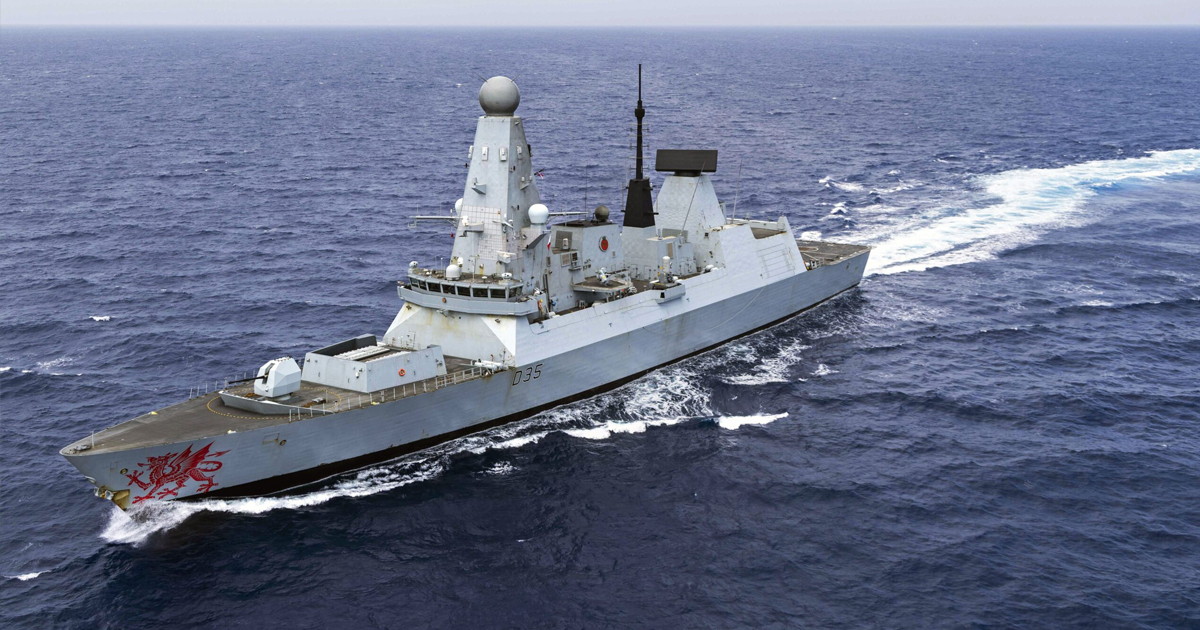
The United Kingdom has deployed the advanced air-defense destroyer HMS Dragon to the Middle East as regional tensions surrounding Iran continue to escalate, with British officials preparing for the possibility of a multinational naval mission aimed at protecting commercial shipping routes through the strategically vital Strait of Hormuz.
According to reports citing the UK Ministry of Defence, the Royal Navy warship is being repositioned closer to the Gulf region after previously operating in the eastern Mediterranean near Cyprus. The deployment forms part of wider contingency planning involving Britain, France and international allies concerned about the growing security risks facing maritime trade in the region.
The Strait of Hormuz remains one of the world’s most critical energy corridors, with a large percentage of global oil and liquefied natural gas shipments passing through the narrow waterway every day.
HMS Dragon Sent to Support Maritime Security Mission
British defence officials confirmed that HMS Dragon is being prepared for potential participation in a broader international maritime protection operation designed to safeguard commercial shipping and maintain freedom of navigation.
The mission is expected to operate under joint British and French leadership and could involve dozens of allied nations already coordinating naval activities in the Gulf and wider Middle East region.
The UK Ministry of Defence described the move as part of ongoing contingency planning as governments monitor growing instability linked to Iran and regional military developments.
The deployment comes as fears increase over threats to shipping traffic, drone attacks, missile launches and possible disruptions to energy supplies moving through the Strait of Hormuz.
Rising Tensions in the Gulf Raise Global Concerns
The latest British military deployment follows months of heightened regional instability involving Iran, Israel, the United States and allied Western powers.
Security concerns have intensified following military confrontations, attacks on shipping and warnings over possible disruptions to global trade routes. The Strait of Hormuz is considered particularly sensitive because nearly a fifth of the world’s oil supply passes through the narrow maritime corridor.
Any disruption in the area can rapidly affect global energy markets, fuel prices and international trade flows.
Western governments have increasingly focused on strengthening naval coordination in the region to deter attacks on commercial vessels and reassure international shipping companies operating through Gulf waters.
HMS Dragon Equipped With Advanced Air Defense Systems
HMS Dragon is one of the Royal Navy’s highly advanced Type 45 guided-missile destroyers, designed primarily for air-defense operations and fleet protection.
The warship’s core capability centers on the powerful Sea Viper missile defense system, regarded as one of the most sophisticated naval air-defense systems currently in service.
The destroyer uses Aster 15 and Aster 30 missiles capable of intercepting a wide range of aerial threats, including aircraft, drones, cruise missiles and anti-ship missiles.
The Aster 15 missile provides shorter-range defense coverage of up to 30 kilometers, while the Aster 30 system can engage targets at distances of up to 120 kilometers.
Military analysts say the ship’s capabilities make it particularly valuable in regions where drone and missile threats have increased significantly in recent years.
Advanced Radar Gives HMS Dragon Wide Surveillance Capability
A key strength of HMS Dragon lies in its radar systems.
The destroyer is equipped with the advanced SAMPSON multifunction radar, which uses active electronically scanned array technology to simultaneously track hundreds of airborne targets.
The ship also carries the long-range S1850M radar system capable of monitoring airspace up to 400 kilometers away while tracking as many as 1,000 targets at the same time.
This combination allows HMS Dragon to function not only as a frontline defense platform but also as a command-and-control vessel coordinating wider air-defense operations for allied naval groups.
The Royal Navy has frequently used Type 45 destroyers as central defensive assets during multinational operations and carrier strike deployments.
British Forces Already Active Near Cyprus
Before moving closer to the Gulf region, HMS Dragon had been operating near Cyprus, where Britain maintains important military infrastructure.
The ship was supporting air-defense operations connected to RAF Akrotiri, one of the UK’s most significant overseas military bases.
Britain has concentrated several regional military assets at Akrotiri, including F-35B stealth fighter jets and Typhoon combat aircraft.
The base has become increasingly important for British and allied operations across the Middle East and eastern Mediterranean.
France Expands Naval Presence in Region
The British deployment also coincides with increased French naval activity.
Earlier this month, the French carrier strike group led by the aircraft carrier Charles de Gaulle reportedly passed through the Suez Canal as part of broader multinational operations linked to regional maritime security.
France and Britain have continued expanding military cooperation in response to growing instability in the Middle East, particularly regarding shipping security and energy infrastructure protection.
The multinational naval mission under discussion is expected to involve coordination between European allies, Gulf partners and other international forces already operating in the region.
Commercial Shipping Remains Vulnerable
Shipping companies operating through the Strait of Hormuz have faced repeated warnings over security threats, including drone attacks, missile strikes and vessel seizures during previous periods of regional escalation.
Insurance costs for commercial shipping in Gulf waters have also increased as tensions have risen.
Energy markets remain highly sensitive to developments in the region because any disruption to shipping lanes can rapidly trigger spikes in global oil and gas prices.
The UK government has repeatedly stressed the importance of maintaining freedom of navigation and protecting international trade routes.
Royal Navy Strengthens Regional Role
The deployment of HMS Dragon highlights Britain’s continuing military role in Middle East security operations despite broader defence pressures and ongoing geopolitical challenges.
British naval forces have regularly participated in international maritime security missions in the Gulf for years, often working alongside US, French and regional allied navies.
Analysts say the latest deployment reflects growing Western concerns over regional escalation and the need to maintain military readiness around key global trade routes.
As tensions continue to evolve, HMS Dragon is expected to remain a central component of Britain’s efforts to reinforce maritime security and support allied naval operations in one of the world’s most strategically important waterways.