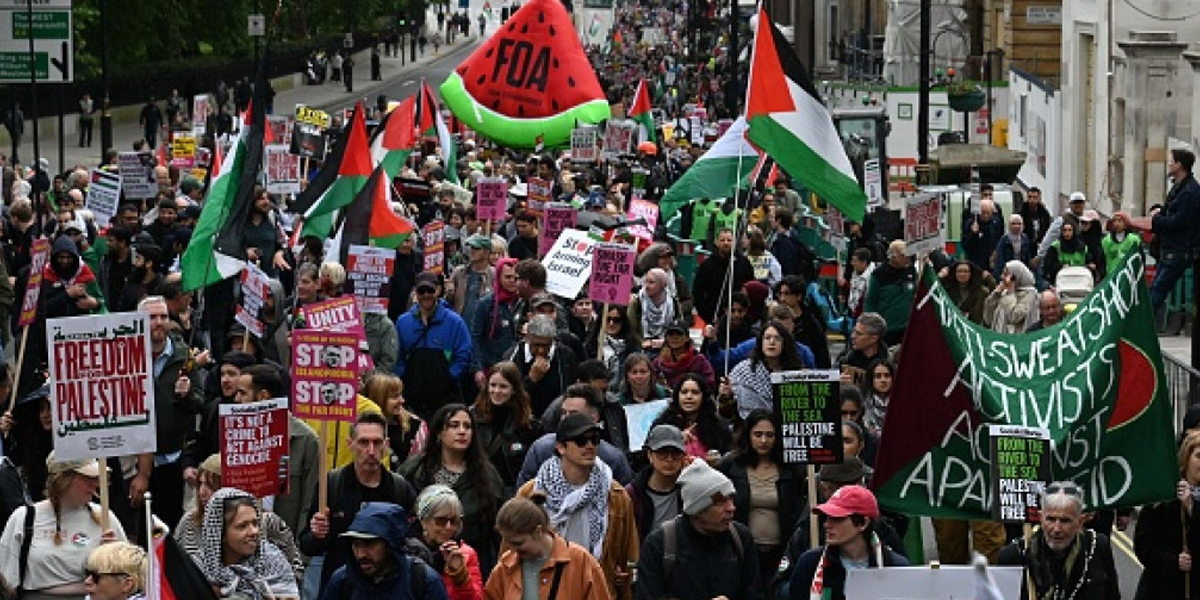
More than 250,000 pro-Palestine demonstrators marched through central London on Saturday during the annual Nakba Day protest, in one of the UK’s largest demonstrations against Israel’s war on Gaza and the rise of far-right movements.
Organisers described the event as a mass mobilisation in solidarity with Palestinians and a direct response to a separate far-right rally held elsewhere in the capital by supporters of Tommy Robinson, whose real name is Stephen Yaxley-Lennon.
The protest commemorated the Nakba — the mass displacement and expulsion of Palestinians during the creation of Israel in 1948 — while also condemning the ongoing war in Gaza.
Large crowds carrying Palestinian flags and anti-war placards marched through London chanting “Free, free Palestine”, while speakers repeatedly accused the British government of supporting Israeli military actions.
Police deployed more than 4,000 Metropolitan Police officers across London, supported by mounted units, drones, helicopters and live facial recognition technology amid concerns over possible clashes between rival demonstrations.
Images from the event showed four generations of Palestinians holding symbolic keys representing homes lost during the Nakba of 1948.
A large screen behind speakers read: “Nakba 78: March for Palestine Unite against Tommy Robinson & the Far Right.”
Speaking during the march, independent MP Zarah Sultana accused Britain of historic and ongoing involvement in Palestinian suffering.
“Britain made the Nakba possible through the Balfour Declaration and colonial rule,” she said.
“Britain armed, supported, and legitimised decades of occupation and apartheid, and today Britain continues to enable Israeli violence through military cooperation, through diplomatic cover, and active participation in genocide.”
Jeremy Corbyn also addressed the crowd, describing the Nakba as the moment “three quarters of a million Palestinians were brutally driven out of their homes”.
“The complicity of Britain will be remembered in history,” Corbyn said while criticising continued British arms sales and political support for Israel.
Holocaust survivor Stephen Kapos rejected claims that the Palestine marches were antisemitic.
“These are not hate marches, quite the opposite,” Kapos said. “We will not tolerate false accusations of anti-Semitism to intimidate us.”
Meanwhile, activists from Jewish Bloc and Friends of Al-Aqsa also spoke during the demonstration, with organisers stressing there was “no place for antisemitism” at the event.
At the same time, Robinson’s “Unite the Kingdom” rally attracted thousands of supporters carrying Union flags, Israeli flags and anti-government placards.
Prime Minister Keir Starmer criticised the far-right rally ahead of the demonstrations, accusing organisers of “peddling hatred and division”.
Police said at least 31 arrests were made during the day, although authorities did not immediately confirm how many were linked to each protest.
Officers worked to keep the demonstrations separated geographically, with the pro-Palestine march assembling in South Kensington while the “Unite the Kingdom” rally began near Holborn.