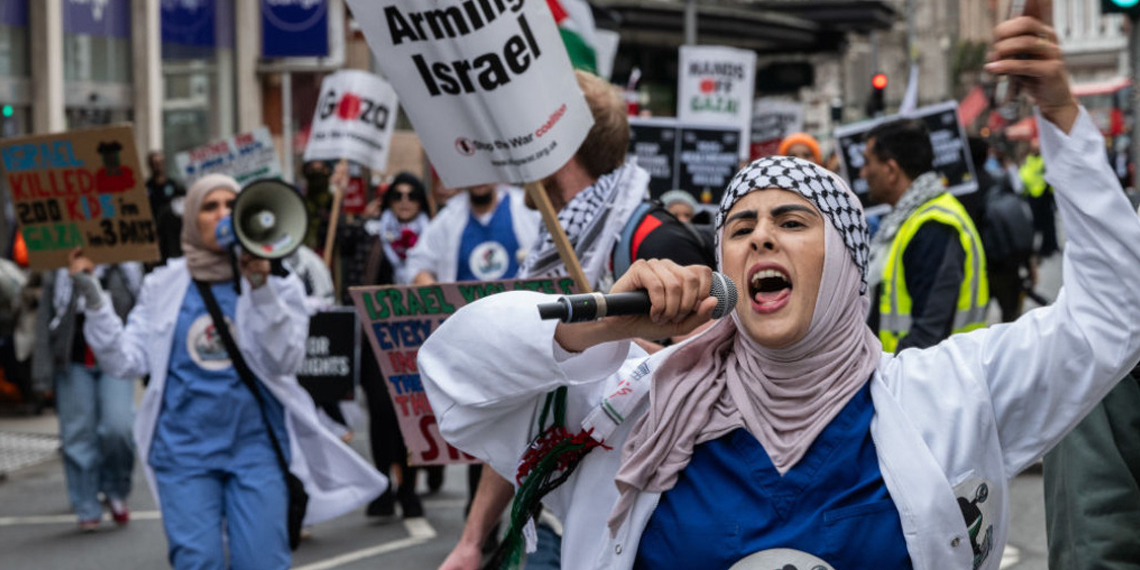
NHS staff in England could be prevented from wearing Palestine badges and other political symbols at work under new recommendations aimed at tackling antisemitism within the health service.
The proposals, published in a review by the government’s independent adviser on antisemitism, call for updated NHS uniform guidance that would restrict the display of political symbols by healthcare workers.
The review was commissioned by former Health Secretary Wes Streeting following allegations of antisemitic behaviour within parts of the NHS.
It claims that some Jewish staff and patients have experienced discrimination, with Jewish employees reportedly “suffer in silence” and some patients concealing their identities due to concerns about hostility.
The recommendations also include mandatory antisemitism training for leaders across England’s 205 NHS trusts and guidance discouraging staff from wearing NHS uniforms at certain political protests.
Lord Mann is understood to have proposed the changes as part of wider efforts to improve inclusion and confidence among Jewish patients and healthcare workers.
However, the proposals have sparked concerns among trade unions and campaigners over free speech and workplace rights.
Helga Pile said: “The review of NHS uniform guidance raises a number of questions and concerns that can’t be answered until it becomes clearer what’s being proposed.”
“There are complex legal issues here including staff rights under the Equality Act and human rights legislation.”
Pile warned that attempts to define political symbols could create legal and practical difficulties.
“There’s a real risk precious time and resources will be spent trying to define a political badge and what staff can wear in their own time.
“No-one wants NHS trusts to be mired in lengthy litigation. This could become a costly distraction from the vital work needed to challenge racist behaviour head-on.”
The proposals have also drawn criticism from some healthcare professionals.
Nadeem Crowe, who was suspended from his NHS role in 2024 following social media posts criticising Israel’s actions in Gaza, argued that the measures could have a chilling effect on freedom of expression.
“What we’re seeing is now this growing extension or protocolization of oppression of any anti-Israel, anti-Zionist speech which has now reached its way into our health service,” he said.
“This kind of policy implementation is absolutely nothing to do with patient safety.”
“It is 100% to do with having a chilling effect.”
Crowe also argued that support for Palestinians should not automatically be viewed as political extremism and expressed concerns about the wider implications for NHS staff.
Meanwhile, the Department of Health and Social Care defended the proposals, insisting they are intended to ensure patients and staff feel respected regardless of their background.
A department spokesperson said: “This isn’t about restricting staff from wearing religious or professional symbols, but instead it will set out a common-sense approach to ensuring that patients and staff feel respected at all times and that political views do not impact upon patients care or comfort.”
Jim Mackey said NHS leaders would move quickly to implement the recommendations.
“We accept all of the recommendations in Lord Mann’s review and as a leadership community, we will act swiftly to implement them,” he said.
“The NHS at its best is a place of compassion, care and unity – not conflict – and there is unacceptable antisemitism and racism in the NHS, faced by both our staff and our patients and we must root this out.”
The debate comes amid a wider legal challenge against the NHS over its adoption of the International Holocaust Remembrance Alliance definition of antisemitism, which some critics argue risks conflating criticism of Israel with antisemitism.