
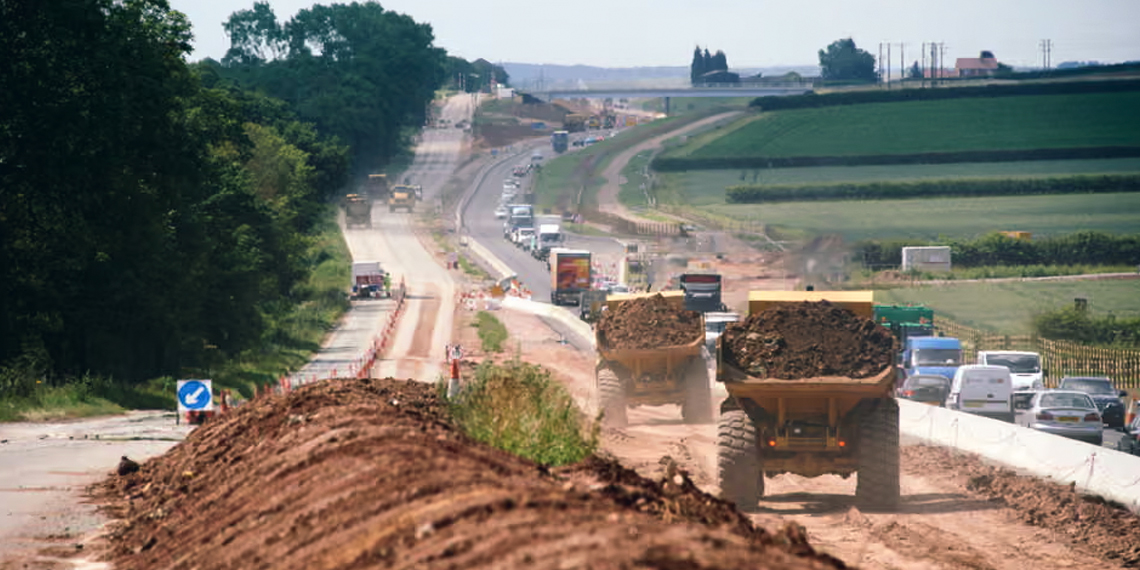
Senior politicians from across the political spectrum have expressed strong opposition to the UK government’s decision to cancel or delay major transport infrastructure projects in order to finance a significant increase in defence spending. The move, which forms part of the government’s new Defence Investment Plan (DIP), has triggered criticism from ministers, Members of Parliament and regional leaders who argue that long-awaited road improvements are being sacrificed at the expense of economic growth and regional development.
The controversy centres on the government’s decision to redirect billions of pounds from departmental capital budgets, including transport and energy, to support an additional £15 billion investment in defence over the coming years. While ministers have defended the spending shift as necessary to strengthen national security amid an increasingly uncertain global environment, opponents contend that the reductions disproportionately affect regions that have already experienced years of underinvestment.
Defence Spending Increase Drives Budget Reallocation
Under the newly announced Defence Investment Plan, UK defence expenditure will increase from 2.6% of gross domestic product (GDP) in 2027 to 2.7% by 2030, bringing total annual defence spending to nearly £80 billion. Prime Minister Keir Starmer stated that the spending trajectory is intended to place the country on a path toward reaching 3% of GDP during the next parliamentary term, although this remains below NATO’s longer-term target of 3.5% by 2035.
To finance the expanded defence programme, the government has chosen to reduce capital spending across several departments, with transport infrastructure among the sectors experiencing the most immediate impact. The overall defence package is projected to cost £298 billion over the next four years, including the newly announced £15 billion allocation.
The investment programme includes substantial commitments to military modernisation, such as £47 billion for new nuclear submarines and £5 billion for drone capabilities, representing an increase over previous defence spending plans.
Road Infrastructure Projects Face Delays
Among the most prominent casualties of the funding reallocation are key road improvement schemes in the East Midlands, including the long-awaited A46 Newark bypass widening project. The project has long been viewed as strategically important for improving transport connectivity between Lincoln, Newark and the wider region while supporting economic development and reducing congestion.
The uncertainty surrounding the future of the scheme prompted an unusually forceful response from Hamish Falconer, Labour MP for Lincoln and the UK’s Middle East Minister. Although expressing support for strengthening national defence, Falconer questioned the decision to postpone a project that has already undergone extensive planning and is widely regarded as delivering strong value for public investment.
He described the A46 upgrade as a strategically significant infrastructure project that has been anticipated for many years and indicated that he intends to seek urgent discussions with the incoming Prime Minister, Chancellor and Transport Secretary following the Labour Party leadership transition to explore options for restoring funding.
Falconer’s intervention is notable given his position within the government, highlighting growing internal concerns regarding the consequences of reallocating infrastructure funding to defence priorities.
Robert Jenrick Condemns Decision
Strong criticism also came from Robert Jenrick, Reform UK MP for Newark, who described the decision as deeply frustrating for local residents.
Jenrick argued that the government’s actions have placed a critical regional infrastructure project into uncertainty despite its long-standing importance to Nottinghamshire and surrounding communities. He accused ministers of introducing the funding changes without sufficient public discussion or consultation and called on the Transport Secretary to provide an immediate explanation regarding the future of the scheme.
The Newark MP further stated that Reform UK leader Nigel Farage has pledged to reverse the infrastructure cuts should the party form a future government. Jenrick said he would continue campaigning for the project to proceed, describing it as essential for the economic development and transport needs of the region.
His remarks reflect wider political disagreement over balancing national defence priorities with domestic infrastructure investment.
East Midlands Mayor Raises Concerns Over Consultation
The government’s handling of the funding announcement has also drawn criticism from Claire Ward, Mayor of the East Midlands, who expressed dissatisfaction with the lack of prior consultation.
Ward revealed that she was informed of the decision only as the Prime Minister was delivering his speech outlining the Defence Investment Plan. She argued that regional leaders should be treated as genuine partners in government decision-making, particularly when significant investment decisions directly affect local economies.
While acknowledging that increased defence spending inevitably requires difficult budgetary trade-offs, Ward questioned why the East Midlands appeared to bear a disproportionate share of the reductions.
According to the mayor, the region stands to lose approximately £900 million in planned road investment, despite decades of previous underinvestment. She argued that concentrating such substantial reductions within a single region undermines efforts to promote balanced regional development across the United Kingdom.
Ward stressed that although she understands the necessity of strengthening national security during a period of heightened geopolitical uncertainty, infrastructure decisions should be distributed more equitably across regions.
Budget Pressures Extend Beyond Current Government
The funding decisions are also expected to create financial challenges for the next administration. Reports indicate that the incoming government will need to identify an additional £4.7 billion in its first budget to fully finance the Defence Investment Plan.
According to sources familiar with internal discussions, the funding shortfall was not fully communicated during briefing sessions on the defence strategy, prompting concern among some officials about how the remaining financial gap will be addressed.
A defence source reportedly described the situation as problematic, suggesting that unresolved funding commitments have effectively been deferred to the incoming administration. Opposition figures likewise criticised the plan, characterising it as leaving a significant financial burden for future governments to resolve.
Balancing National Security and Economic Development
The debate surrounding the Defence Investment Plan highlights the increasingly difficult choices facing policymakers as governments attempt to strengthen national security while maintaining investment in public infrastructure.
Supporters of increased defence spending argue that evolving international security risks require sustained investment in military capability, strategic deterrence and defence technology. They contend that modernising armed forces and strengthening national resilience are essential priorities given ongoing geopolitical tensions.
Conversely, critics argue that transport infrastructure plays a fundamental role in supporting regional economies, improving productivity and encouraging long-term investment. Delays to major road projects, they warn, could hinder economic growth, reduce connectivity and postpone benefits that communities have awaited for years.
As discussions continue over the implementation of the Defence Investment Plan, pressure is expected to mount on ministers to justify how infrastructure reductions have been allocated and whether alternative funding mechanisms can be identified to prevent further delays to strategically important transport projects.
The debate ultimately reflects a broader policy challenge confronting governments worldwide: balancing immediate national security requirements with sustained investment in domestic infrastructure that underpins long-term economic prosperity and regional development.