
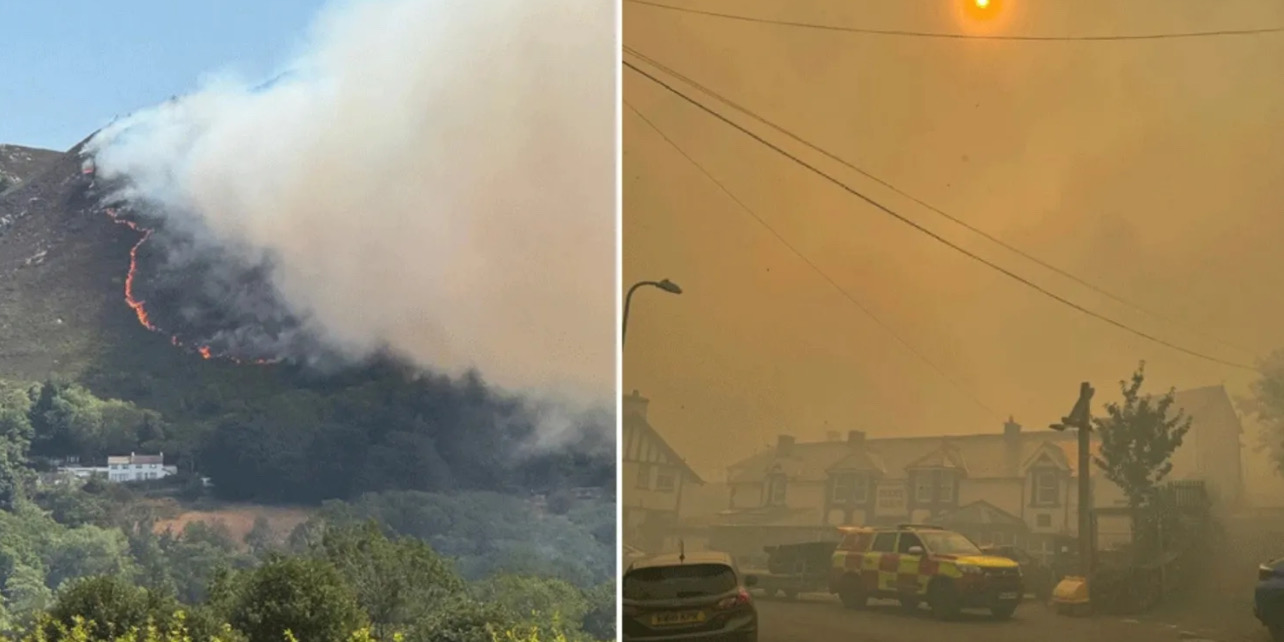
A major emergency has been declared in north Wales after a rapidly spreading wildfire threatened communities near Conwy Mountain, highlighting the growing impact of extreme weather as firefighters continue battling multiple blazes across England and Wales. Emergency services remain on high alert as record-breaking temperatures, prolonged dry conditions and strong winds combine to create one of the highest wildfire risks experienced in recent years.
Authorities ordered precautionary evacuations in areas surrounding Conwy Mountain and the Sychnant Pass after the fire intensified, while residents across nearby communities were urged to remain indoors, keep windows and doors closed and follow emergency guidance. The declaration of a major incident underscores the seriousness of the situation as fire crews work in difficult conditions to prevent further spread of the blaze.
The wildfire emergency comes as numerous fires continue to burn across several regions of the UK, placing increasing pressure on emergency services already responding to an exceptionally active wildfire season driven by persistent heatwaves and below-average rainfall.
North Wales Wildfire Prompts Evacuations
North Wales Fire and Rescue Service confirmed that firefighting operations around Conwy Mountain remain ongoing, describing conditions as highly challenging due to dry vegetation, steep terrain and weather conditions that continue to accelerate the spread of flames.
Residents living near Capelulo, close to Conwy Mountain, were advised to leave the area safely after local authorities issued evacuation guidance as a precautionary measure. Emergency responders also advised neighbouring communities to remain vigilant, avoid unnecessary travel and seek medical attention if smoke exposure caused breathing difficulties.
Firefighters have simultaneously responded to additional grass fires across the region, including incidents in Braichmelyn Forest near Bethesda, demonstrating the widespread pressure facing emergency services throughout north Wales.
Authorities warned that operations could continue for an extended period until changing weather conditions improve containment efforts.
Wildfires Reported Across England
The wildfire emergency extends well beyond Wales, with fire and rescue services responding to multiple major incidents throughout England.
In Greater Manchester, firefighters are working to contain a large moorland fire near Dovestone Reservoir. Officials warned that strong winds could carry smoke over considerable distances, prompting residents to keep windows closed and avoid affected areas where possible.
In Camberley, on the Surrey-Hampshire border, emergency crews continued monitoring hotspots after bringing a substantial heathland wildfire under control. The fire spread across approximately 10 hectares of heathland before firefighters successfully limited further expansion through overnight operations.
Elsewhere, wildfire incidents have also been reported across County Durham, Derbyshire, Devon, Somerset, East Sussex and West Sussex.
In County Durham, firefighters extinguished a wildfire covering an area comparable to approximately fourteen football pitches after receiving emergency calls during the afternoon. Meanwhile, West Sussex Fire and Rescue Service deployed multiple vehicles to tackle a field fire near Chichester.
These incidents follow a series of significant wildfires that affected numerous parts of England during previous days as temperatures continued climbing.
Extreme Weather Creates Exceptional Fire Risk
Natural England has warned that southern England and parts of the South Midlands currently face the highest wildfire danger, with many other areas across England and Wales classified as experiencing a very high risk.
Meteorologists attribute the heightened danger to several consecutive heatwaves combined with prolonged periods of limited rainfall. These conditions have left grasslands, forests, heathlands and moorland exceptionally dry, allowing even small ignition sources to develop rapidly into large-scale wildfires.
Weather experts also note that strengthening winds and declining humidity further increase the likelihood of fires spreading quickly while making containment significantly more difficult for emergency responders.
Although forecasts suggest some improvement later in the week as winds weaken and isolated showers become more likely, authorities continue urging the public to exercise extreme caution in outdoor areas.
Derbyshire and South Downs Continue Recovery Efforts
Firefighters in Derbyshire remain engaged in operations connected to a long-running wildfire near Arnfield Farm and Tintwistle Moor, where helicopters have continued conducting aerial water drops to extinguish remaining hotspots.
The wildfire, which initially began during a previous heatwave in late June, has already affected approximately 260 hectares of moorland and woodland, illustrating the long-term environmental impact of prolonged dry weather.
Further south, emergency crews in East Sussex and West Sussex recently tackled separate wildfires within the South Downs National Park, including incidents near Devil’s Dyke and Eastbourne.
Meanwhile, fire services across Devon and Somerset responded to multiple grassland fires during the weekend as soaring temperatures continued placing vegetation under severe stress.
Heatwave Raises Wider Public Safety Concerns
The wildfire crisis coincides with continuing heat health alerts issued by the UK Health Security Agency, which has placed large parts of England under amber and yellow warnings through midweek.
Health officials warn that prolonged periods of high temperatures may significantly increase pressure on hospitals, ambulance services and social care providers while raising health risks for vulnerable populations, particularly older adults and individuals with pre-existing medical conditions.
Authorities have also renewed warnings regarding water safety after several fatal incidents involving open-water swimming occurred during the recent spell of hot weather.
Emergency services continue encouraging the public to avoid unnecessary risks near reservoirs, lakes, rivers and coastal waters, where sudden changes in water temperature and strong currents can quickly become life-threatening.
Climate Change Increasing Frequency of Wildfires
Environmental experts increasingly link the growing frequency and intensity of UK wildfires to climate change, which is contributing to higher average temperatures, longer periods of drought and more frequent extreme weather events.
As vegetation becomes drier during prolonged heatwaves, landscapes become significantly more susceptible to ignition from accidental causes, discarded smoking materials, barbecues, machinery or natural factors.
Scientists warn that unless greenhouse gas emissions are significantly reduced and climate resilience measures strengthened, wildfires may become a more regular feature of British summers.
Emergency planners are also reviewing long-term strategies to improve wildfire preparedness, strengthen public awareness campaigns and invest in firefighting capabilities capable of responding to increasingly complex incidents.
Authorities Urge Continued Vigilance
Emergency services continue urging residents across England and Wales to remain alert while wildfire risks remain exceptionally high.
Officials advise avoiding activities that could accidentally ignite dry vegetation, following local safety instructions and immediately reporting any signs of smoke or fire to emergency services.
With weather conditions expected to remain challenging for several more days, authorities stress that public cooperation will remain essential in preventing additional wildfire outbreaks while allowing firefighters to focus resources on protecting lives, homes and critical natural habitats across the United Kingdom.