
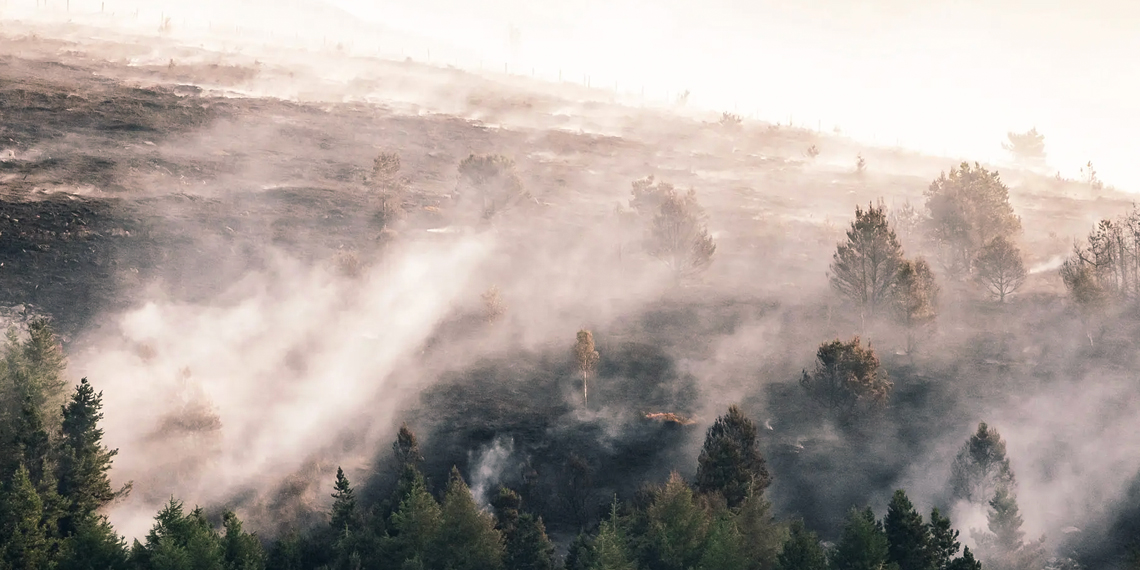
Large parts of the British countryside are facing an “extreme” risk of wildfires as the UK endures its third heatwave of 2026, with firefighters tackling major blazes across England.
Emergency crews continued battling a moorland fire in the Peak District over the weekend, using helicopter water drops to contain the blaze near Glossop, Derbyshire. Eight fire engines and a helicopter were deployed as walkers were urged to avoid closed footpaths.
The fire first broke out more than two weeks ago and has spread across over 600 acres of moorland.
Elsewhere, firefighters worked through Friday night to tackle a wildfire at Devil’s Dyke in the South Downs National Park. Eight fire engines and five specialist support vehicles were sent to the scene.
The Natural Hazards Partnership has issued a red alert for an extreme wildfire risk across southern England, the Midlands and parts of northern England. Officials expect the warning to extend across much of Wales over the weekend.
The alert comes as soaring temperatures fuel devastating wildfires across Europe. In Spain’s Almería province, one of the country’s worst-ever wildfires has claimed 12 lives.
The Forestry Commission warned that low humidity and strong winds are creating ideal conditions for fires to ignite and spread rapidly.
Farmers have also expressed concern that the dry landscape could allow fires to spread across large areas within minutes.
John Shears, who farms 80 acres near Dartmoor, described the current conditions as the worst since the summer heatwave of 1976.
“If a fire was to start now, there would be no stopping it,” he said. “It would go too fast. It would wipe out the forest of Dartmoor in no time at all.”
Richard Drysdale, director of conservation and communities at Dartmoor National Park Authority, said the park has firebreaks and a wildfire management plan in place, but stressed that public awareness remains essential.
“We have tragically seen in Spain the speed at which wildfires can move,” he said.
“People might think that they can outrun it or be able to escape, but if a wildfire takes hold there can be loss of human and animal life.”
Authorities are urging people not to light fires or disposable barbecues in the countryside, to take litter home and to help reduce the risk of accidental fires.
According to the National Fire Chiefs Council, fire and rescue services in England and Wales recorded 342 wildfires between 1 January and 6 July this year, compared with 639 during the same period in 2025.
Meanwhile, hundreds of firefighters supported by helicopters remain on the front line in south-eastern Spain, where a wildfire has burned around 25 square miles of forest and farmland.
Spanish authorities said four of the 12 people who died are believed to be British. Officials also reported that several victims failed to follow the recommended evacuation route, with seven people dying after abandoning their vehicles.
Wildfires have also continued to affect Portugal and Greece as Europe experiences one of its hottest summers on record. EU meteorological data confirmed that last month was the hottest June ever recorded in western Europe.