
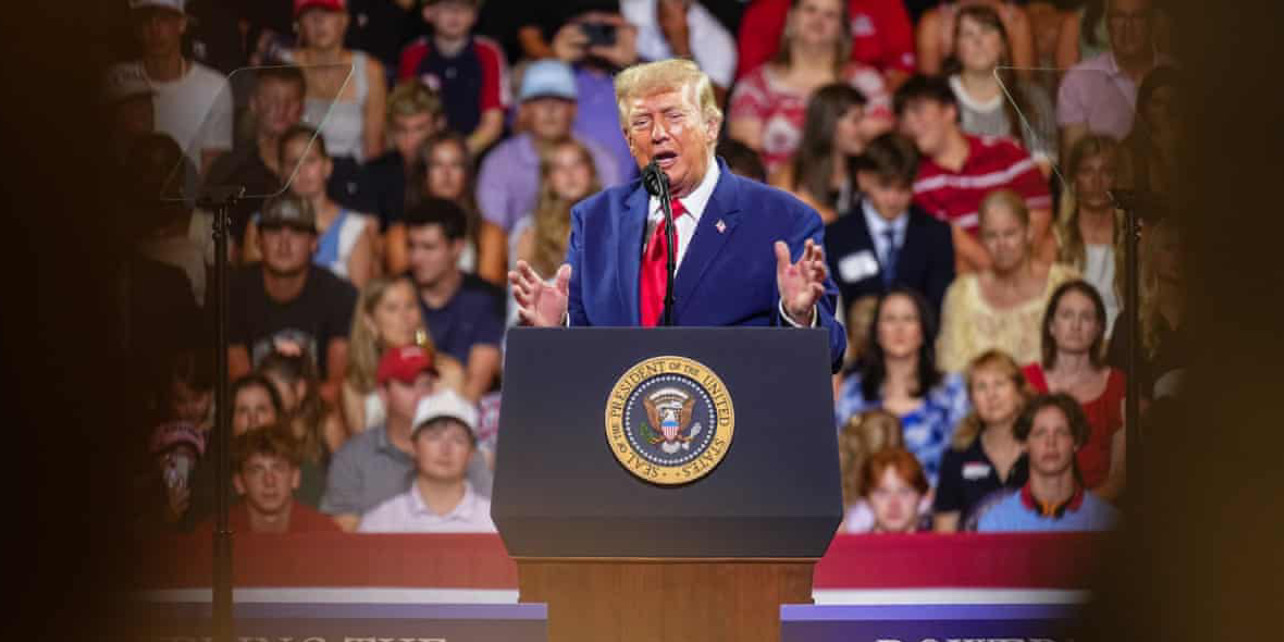
US President Donald Trump has announced a new round of tariffs on imports from more than 80 countries, including the UK, the European Union, Canada, Australia, China, India and Mexico, replacing the temporary 10% global tariff introduced earlier this year.
The new measures, announced by US Trade Representative Jamieson Greer, impose tariffs of between 10% and 12.5% under Section 301 of the Trade Act of 1974, which allows trade action against countries linked to forced labour practices.
The tariffs replace the blanket 10% levy introduced in February after the US Supreme Court ruled that many of Trump’s earlier tariff measures were unlawful.
Greer said the latest action was intended to encourage stronger action against forced labour.
“The United States has had a forced labor import ban for nearly a century, and rigorously enforces it; it’s well past time for our trading partners to do the same.”
“I am encouraged by the trading partners who have moved quickly to adopt forced labor import prohibitions, and look forward to ensuring their effective enforcement.”
The move triggered immediate criticism from several US allies.
Australia and Brazil described the tariffs as unjustified and said they would seek their removal, while Norway questioned the legal basis for the measures.
European Union foreign policy chief Kaja Kallas said Brussels would seek clarification from Washington, adding that the bloc had honoured commitments under last year’s transatlantic trade agreement and viewed the new tariffs as a shock.
Canada also criticised the decision, arguing it should not have been included.
Matthew Holmes, Executive Vice-President of the Canadian Chamber of Commerce, said: “If the intent is truly to address forced labour, the focus should be a coordinated approach through a multilateral mechanism.”
“The timing of this is somewhat suspect as previous rounds of tariffs sunset.”
Trump has repeatedly described tariffs as a key part of his economic strategy, arguing they protect American jobs, strengthen manufacturing and reduce trade deficits. He has previously called tariffs “the most beautiful word in the dictionary”.
However, the legal basis for the latest measures has already come under scrutiny.
Alan Wolff, a senior fellow at the Peterson Institute for International Economics and former Deputy Director-General of the World Trade Organization, said: “The answer is no: Congress did not delegate authority of such breadth to the president. It cannot constitutionally do so.”
“These new tariffs would represent another case of presidential overreach. If they were challenged in court, the supreme court would likely overturn them.”
The tariffs also remain unpopular with many American voters.
A Harris Poll conducted earlier this year found that seven in ten Americans believed Trump’s tariffs had increased prices, while 72% said they had harmed consumers overall.
Even among Republican voters, 64% believed the tariffs had led to higher prices and 60% said they had negatively affected consumers.
Despite the criticism, the Trump administration insists its trade policies are benefiting the US economy.
During a Senate hearing, Greer rejected claims that tariffs had pushed up household costs, replying simply: “No.”
He added: “Core inflation fell to 2.6% year on year, much better than in January 2025.”