
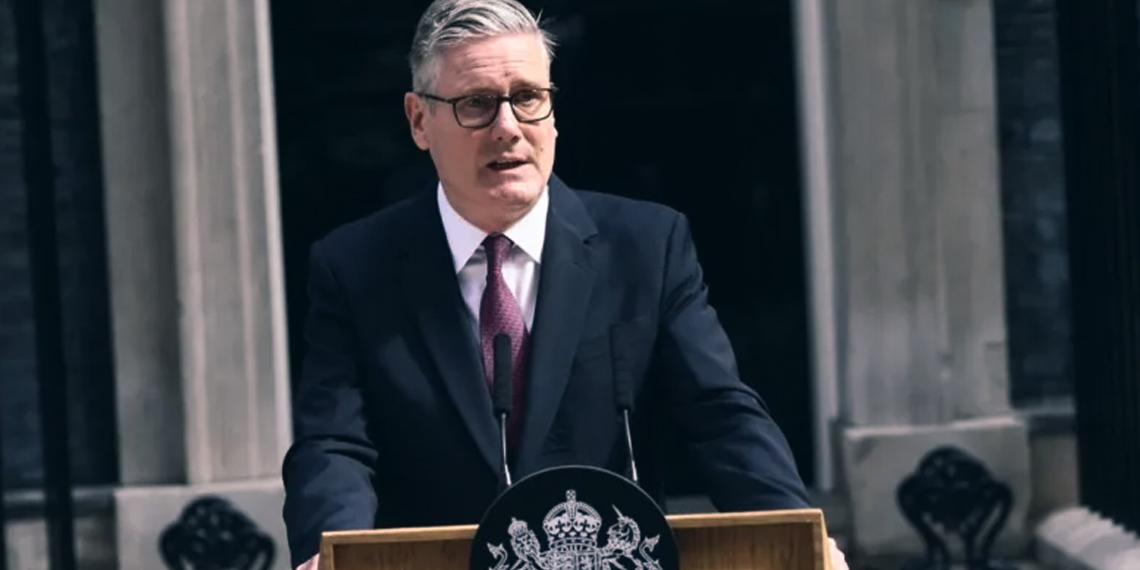
Prime Minister Sir Keir Starmer has announced his resignation as both leader of the Labour Party and head of the UK government, setting in motion a leadership contest that will determine Britain’s next prime minister. The decision marks a significant turning point in UK politics and ushers in a new phase for the governing Labour Party less than two years after its general election victory.
Speaking outside 10 Downing Street, Sir Keir confirmed that he had informed King Charles III of his intention to step down, explaining that he no longer believed he was the right person to lead Labour into the next general election. While announcing his departure, he emphasized his commitment to ensuring a smooth and orderly transition, pledging to remain in office until the party elects a new leader.
The resignation is expected to reshape the political landscape, with several high-profile Labour figures already emerging as potential successors. Once the leadership process concludes, the United Kingdom will have its seventh prime minister since 2016, reflecting a decade of rapid political change.
Leadership Transition Timeline Announced
Alongside his resignation statement, Sir Keir outlined the timetable for selecting Labour’s next leader. He confirmed that the party’s governing body will oversee the process, with nominations scheduled to open on 9 July and close before Parliament’s summer recess on 16 July.
Should multiple candidates enter the race, Labour members will participate in a leadership contest designed to conclude before Parliament reconvenes in September. The timetable is intended to minimize political uncertainty while allowing the governing party to maintain stability during the transition period.
Sir Keir stated that he would fully support whoever succeeds him, expressing confidence that the incoming leader would inherit a country stronger and fairer than the one his administration took office to govern.
Starmer Reflects On His Political Journey
Sir Keir Starmer became Labour leader in April 2020 and guided the party to victory in the 2024 general election, ending years of Conservative government and securing his position as prime minister on 5 July 2024.
During his resignation address, he reflected on his time in office while expressing gratitude to colleagues, supporters and his family. Accompanied by his wife, Victoria, he delivered an emotional speech in which he acknowledged the personal sacrifices associated with leading the country.
He said his next priority would be spending more time with his family, describing his wife as a constant source of strength throughout his political career and reaffirming his commitment to being present for his children after leaving the nation’s highest office.
The personal remarks added a human dimension to an announcement that carries significant constitutional and political implications.
Internal Pressure Accelerated Departure
Sir Keir’s decision follows weeks of mounting pressure from within the Labour Party for clarity regarding its future leadership.
Calls for a succession timetable intensified after Andy Burnham secured a decisive victory in the Makerfield by-election, returning to Westminster with a commanding performance that strengthened his standing among Labour members and supporters.
Many political observers now regard Burnham, the former Greater Manchester mayor, as one of the leading contenders to succeed Sir Keir and become both Labour leader and prime minister.
Burnham is expected to formally resume his parliamentary role in the coming days, positioning himself at the centre of discussions surrounding the party’s future direction.
Potential Successors Begin To Emerge
While Andy Burnham is widely viewed as an early frontrunner, he is unlikely to be the only candidate seeking Labour’s leadership.
Former Health Secretary Wes Streeting has previously indicated his intention to participate in any leadership contest, raising the prospect of a competitive race featuring some of Labour’s most prominent figures.
The contest is expected to focus on economic management, public service reform, housing, healthcare and Labour’s electoral strategy ahead of the next general election.
Party members will also assess which candidate is best positioned to unite different factions within Labour while maintaining public confidence in the government’s agenda.
Political Challenges Shaped Leadership Decision
Sir Keir’s departure comes after a challenging period marked by declining internal support and criticism over several policy decisions.
Earlier this year, Labour altered its position on three major policy areas following pressure from MPs and party members, prompting questions about the government’s consistency and long-term direction.
The administration also faced scrutiny over the appointment of Lord Mandelson as UK ambassador to the United States. The appointment attracted controversy after additional information emerged regarding Mandelson’s relationship with the late convicted sex offender Jeffrey Epstein, leading critics to question the judgement of Downing Street and the wider leadership team.
Combined with disappointing election performances across England, Wales and Scotland in May, these developments contributed to growing dissatisfaction among sections of the parliamentary party.
Labour Enters A New Political Chapter
The leadership transition represents a defining moment for Labour as it seeks to maintain government stability while selecting a successor capable of leading both the party and the country.
Sir Keir’s commitment to remaining in office until the contest concludes is intended to provide continuity during the process and reassure financial markets, public institutions and international partners.
With nominations opening in July and a new leader expected before Parliament returns in September, attention will now shift to the candidates seeking to shape Labour’s next chapter.
The outcome of the leadership contest will not only determine the identity of the United Kingdom’s next prime minister but also influence the government’s priorities, political direction and electoral strategy for years to come, making it one of the most consequential developments in recent British politics.