
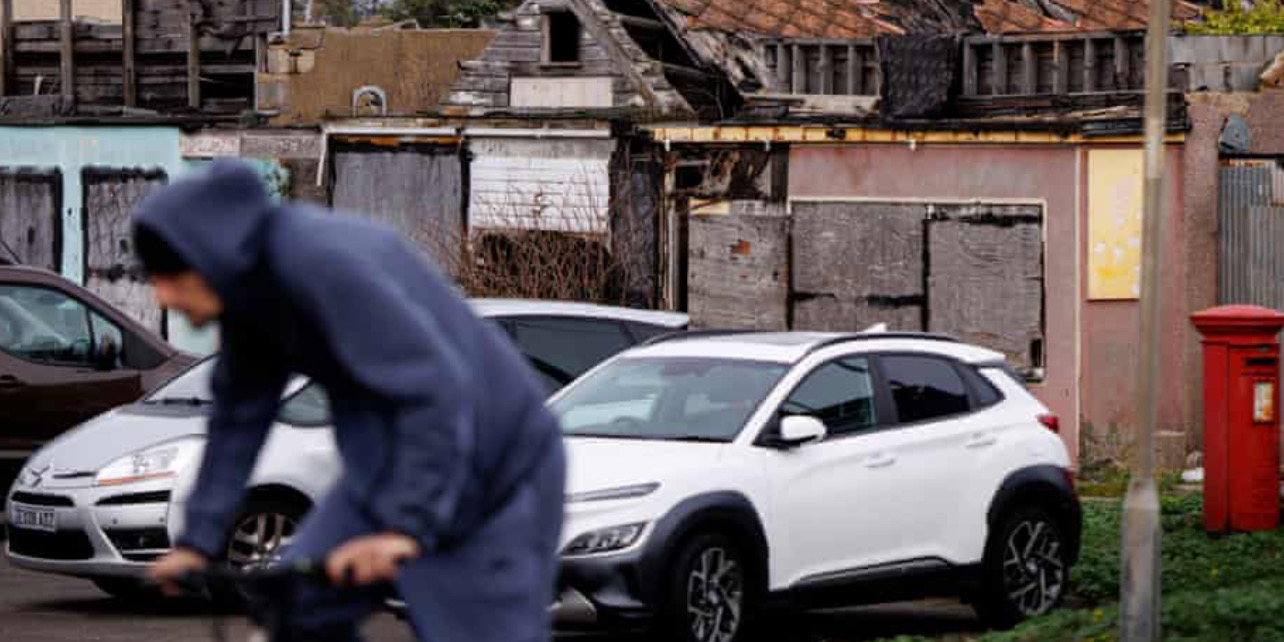
Britain’s most deprived neighbourhoods are on course to see higher crime and rising unemployment by the end of the current parliament, despite government pledges to level up struggling communities, according to a report commissioned by Downing Street.
Forecasts by the Independent Commission on Neighbourhoods (ICON) suggest that crime rates and economic inactivity will increase across the 613 most disadvantaged communities in England before the next general election. These areas, home to around one million people, are concentrated in former industrial towns across the Midlands and the North and are already experiencing significantly worse outcomes than the national average.
The analysis indicates that current government investment will not be enough to reverse long-term trends such as rising antisocial behaviour, declining high streets and job losses in retail and hospitality.
Crime and Unemployment Set to Rise
According to the report, average crime in the most deprived neighbourhoods currently stands at 275 offences per 1,000 people, more than double the national rate. By the end of the decade, this is forecast to exceed 300 per 1,000. Economic inactivity is also expected to climb, rising from 45% this year to around 46% by 2030.
While health outcomes are projected to improve slightly, with the proportion of residents in poor health falling marginally, researchers warn that social and economic conditions will continue to deteriorate without a major funding shift.
Northern Towns Under Financial Pressure
Ross Mudie, ICON’s head of research and the report’s author, said councils serving the most deprived communities are facing real-terms funding cuts. He warned that even with recent increases in regeneration funding, local authorities in places such as Blackpool and Knowsley remain in a weaker financial position than a decade ago.
Labour MPs from northern England have raised concerns that changes to local government funding formulas could further drain resources from towns already struggling with long-term decline.
Political Stakes for Labour and Reform UK
The findings pose a challenge for Prime Minister Keir Starmer, who has made tackling regional inequality and regenerating left-behind communities central to his political agenda. Many of the areas identified as “mission critical” by ICON were once Conservative strongholds, swung to Labour in 2024, and are now being targeted by Reform UK.
Former Labour minister Justin Madders said the report was a warning that current policies may not be sufficient to reverse years of decline, arguing that failure to deliver visible improvements could open the door to populist parties.
Pride in Place Funding ‘Not Enough’
The government’s flagship Pride in Place programme, which will invest £20m over 10 years in each of 250 areas, was described by ICON as a starting point rather than a solution. The commission said a far bolder approach is needed to counter the legacy of austerity, weakened local services and decaying town centres.
In a separate recommendation, ICON called for an additional £2.5bn a year to be directed at the most deprived neighbourhoods to tackle crime, unemployment, poor housing and educational disadvantage.
Government Response
Local government minister Miatta Fahnbulleh said communities were “impatient for change” and pointed to £5bn of planned investment over the next decade. She said the government’s 10-year plan aimed to improve public services, boost jobs and restore confidence in areas that have been left behind for too long.