
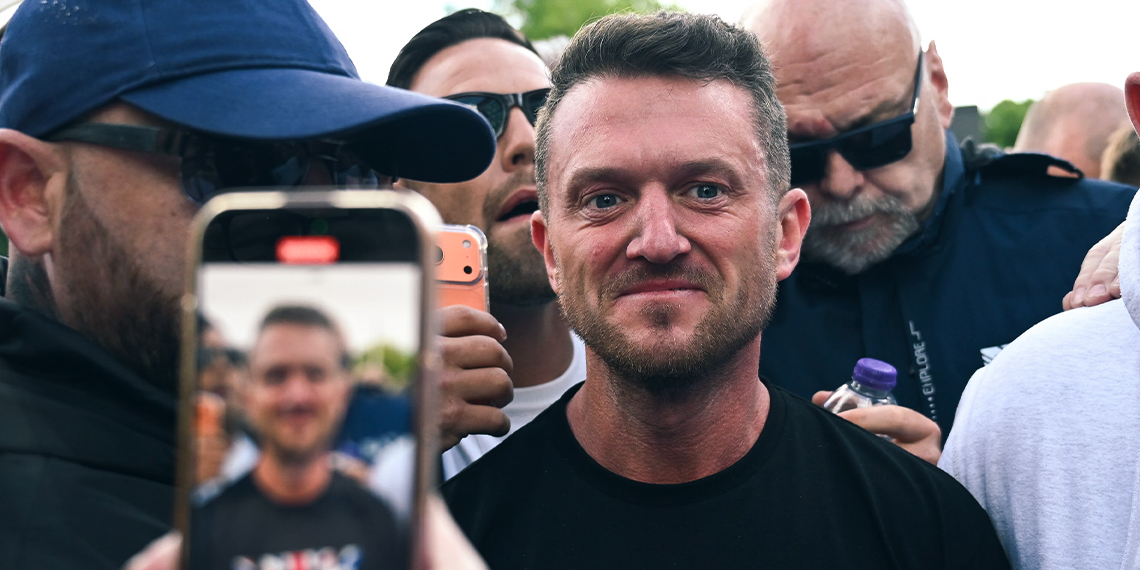
Far-right activist Tommy Robinson was detained by police at Heathrow Airport on Saturday under counter-terrorism legislation, following a week in which his online profile gained renewed attention.
Robinson, whose real name is Stephen Yaxley-Lennon, was stopped by officers under Section 3 of the Counter-Terrorism and Border Security Act 2019. The legislation grants authorities powers to question, search and detain individuals at ports and borders if they are suspected of involvement in hostile activities.
According to Robinson, the detention lasted nearly three hours and resulted in the seizure of his mobile phones, including an iPhone and a Samsung Galaxy device.
Supporters of Robinson later claimed on social media that authorities were attempting to gain access to his communications and sources. They described the action as an attack on free speech and investigative journalism, allegations that have not been substantiated by police.
The Metropolitan Police declined to comment on the circumstances surrounding the detention, and officials have not disclosed the specific reason for the stop.
Robinson, 43, has attracted increased public attention in recent weeks amid heightened tensions following the death of 18-year-old Henry Nowak while in police custody in Southampton. The incident sparked protests in Hampshire, with Robinson playing a prominent role in public demonstrations.
Several clashes between protesters and police during the unrest resulted in injuries to officers and a police dog.
The activist has also been active on social media, sharing content related to a suspected attempted murder in Belfast and promoting demonstrations across the UK and Northern Ireland. One of his posts was later shared by Elon Musk, significantly expanding its reach.
This is not the first time Robinson has faced scrutiny under counter-terrorism legislation. In July 2024, he was stopped by police at the Channel Tunnel in Folkestone while travelling to Spain. Officers requested access to his mobile phone, but Robinson refused, arguing that the device contained confidential journalistic material.
He was later cleared of a related terrorism offence after a judge ruled there was insufficient certainty that the police stop had been lawful.
The latest Heathrow detention is likely to reignite debate around the use of counter-terrorism powers at UK borders, particularly in cases involving high-profile political activists and public figures.
Authorities have yet to confirm whether any further action will be taken following the incident.