
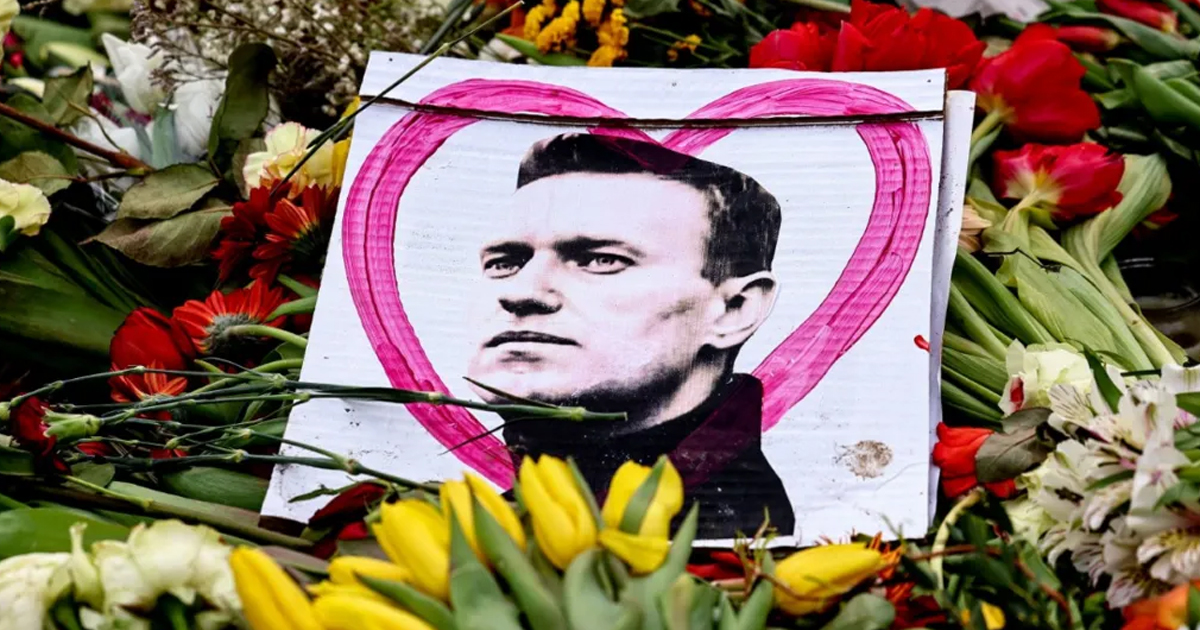
The United Kingdom has called for international action against Russia after European laboratories concluded that opposition leader Alexei Navalny died from a rare toxin derived from frog poison, Foreign Secretary Yvette Cooper has said.
Navalny, a prominent critic of President Vladimir Putin, died two years ago in a Siberian penal colony where he had been imprisoned on what his supporters described as politically motivated charges. Moscow initially claimed he died of natural causes.
However, new forensic findings from five European countries — based on samples reportedly smuggled out of Russia — indicate that the substance responsible was developed from a toxin found in Ecuadorian dart frogs.
Speaking at the Munich Security Conference, Cooper told the BBC that the evidence pointed directly to the Kremlin.
“The proof of the toxin is a clear breach of international chemical weapons rules and we do want to see action,” she said.
The foreign secretary added that only the Russian government had the “means, motive and opportunity” to deploy such a substance.
Cooper confirmed that a group of European ministers had referred the findings to the Organisation for the Prohibition of Chemical Weapons (OPCW).
“We see this as a clear breach of the chemical weapons international rules and convention so we do want to see action there, holding some accountability,” she said.
She warned that the use of poison “is evidence of the aggression that is unfortunately going to be continuing” and stressed that Britain and its allies must be prepared to respond collectively.
“We continue to look at co-ordinated action, including increasing sanctions on the Russian regime,” she added.
The UK government has already imposed multiple rounds of sanctions on Moscow in response to Russia’s invasion of Ukraine, which is approaching its fourth anniversary.
“It is the partnerships that we build abroad that make us stronger at home,” Cooper said. “It is by acting alongside our European allies, alongside allies across the world, that we do maintain that pressure on the Russian regime.”
The Russian embassy in London dismissed the findings, accusing Western governments of spreading misinformation.
“There is no reason whatsoever to credit such ‘findings’ by Western ‘experts’,” the embassy said in a statement.
It continued: “We have become accustomed to the feeble-mindedness of Western fabulists. One must ask what kind of person would believe this nonsense about a frog.”
The statement also accused critics of engaging in “necro-propaganda”.
Navalny’s widow, Yulia Navalnaya, has consistently maintained that her husband was “murdered” through poisoning.
Conservative shadow foreign secretary Dame Priti Patel called on the government to intensify measures against Moscow, arguing that existing sanctions are “being busted and circumvented”.
“We need to do much more, I think, when it comes to action against Russia,” she said.
She urged ministers to consider “cutting off all the financial flows that are basically still propping up Russia and the Russian economy”, including targeting businesses and energy infrastructure.
“We’ve really got to start taking direct action against these financial lifelines that basically are propping up Russia, the Russian state,” she said.
The latest developments further strain already fragile UK-Russia relations, which have been tense since the Salisbury Novichok poisoning and the outbreak of war in Ukraine.
For the UK government, the alleged use of a lethal toxin against a political prisoner represents not only a domestic Russian issue but a violation of international chemical weapons conventions — one that could prompt fresh diplomatic and economic consequences.
As Cooper emphasised in Munich, Britain and its allies are determined to pursue accountability.
“We have been pursuing the truth on this since Alexei died in prison,” she said.