
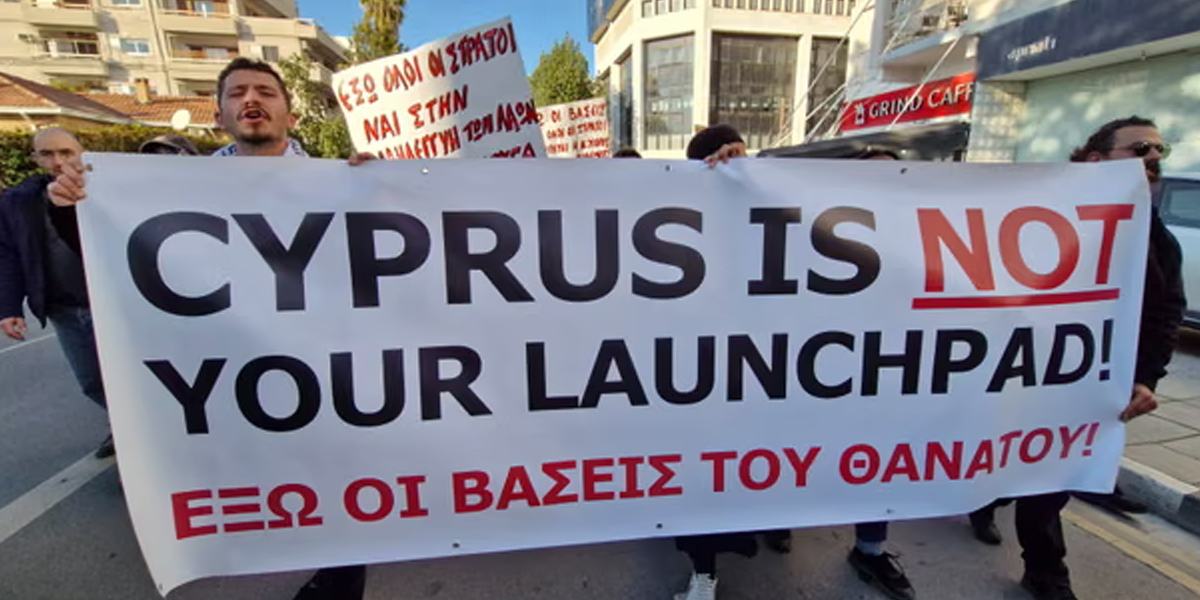
Growing anger over British military installations on the island has triggered demonstrations as Cyprus protests British military bases after RAF Akrotiri drone attack, with thousands calling for the closure of UK sovereign base areas following a security breach that heightened fears of regional escalation.
Demonstrators marched through the capital Nicosia demanding the removal of British bases they say are putting the Mediterranean nation at risk of becoming entangled in the widening conflict involving Iran and its regional allies. Protesters accused the installations of threatening Cyprus’ security after an Iranian-made drone struck RAF Akrotiri, one of the United Kingdom’s most important overseas military bases.
The unprecedented attack has intensified debate in Cyprus about the continued presence of British sovereign base areas that were retained by the UK when the island gained independence in 1960.
Protesters demand closure of British bases
Hundreds of protesters gathered in Nicosia on Saturday before marching toward the presidential palace, chanting slogans including “out with the bases of death” and calling for the withdrawal of British military forces.
Many demonstrators argued that the bases have become a liability as tensions escalate across the Middle East.
Mathaios Stavrinides, one of the protesters, said the facilities posed a direct threat to national security.
“They are a danger to our security and should never have been here in the first place,” he said. “We want them closed.”
The demonstrations reflect long-standing resentment among some Cypriots toward the British military presence, which critics view as a legacy of the island’s colonial past.
Drone attack raises security concerns
The protests follow an unprecedented drone strike on RAF Akrotiri, which Cypriot authorities say was launched from Lebanon.
Cyprus foreign minister Constantinos Kombos confirmed that the explosive-packed drone originated from Lebanese territory, where the Iran-backed group Hezbollah operates alongside units linked to the Islamic Revolutionary Guard Corps.
Less than 12 hours after the first drone crashed into the base, two additional combat drones were detected and intercepted at sea off the island’s coast.
The drones were also believed to have been launched from Lebanon, approximately 150 miles east of Cyprus.
“Right now it’s a fact that we have to be looking towards the Lebanese front,” Kombos said.
He added that security officials must remain vigilant because threats could emerge from multiple directions across the region.
British bases seen as potential targets
Cypriot officials say the attacks appear to have targeted the British bases rather than the Republic of Cyprus itself.
Nicosia has repeatedly warned that the UK military installations could become targets if regional tensions intensified.
According to government officials, Cyprus raised concerns with the UK government as early as last year about the potential risks posed by the bases during a broader Middle East conflict.
“We’ve consistently communicated that the bases could be a target if things move in a specific direction regionally,” Kombos said.
However, officials suggest that the warnings were not addressed with the urgency they believed necessary.
Strategic role of RAF Akrotiri
RAF Akrotiri is considered one of the UK’s most important military facilities outside Britain.
The base serves as a key operational hub for British and allied missions in the Middle East, including air operations, surveillance and logistical support.
The UK retained sovereignty over the base areas at Akrotiri and Dhekelia when Cyprus gained independence from Britain in 1960. Together, the sovereign base areas cover roughly 3% of the island’s territory.
Akrotiri has been used extensively for operations in Iraq and Syria and plays a critical role in NATO and Western military planning across the eastern Mediterranean.
Military reinforcements deployed to Cyprus
In response to the drone attack, several European countries have deployed naval and air assets to the region at Cyprus’ request.
The UK has reinforced air defence capabilities at RAF Akrotiri, including the deployment of Royal Navy Wildcat helicopters capable of intercepting aerial threats.
Additional F-35 fighter jets were also sent to the base last month to strengthen the UK’s military presence in the region.
Meanwhile, the Royal Navy destroyer HMS Dragon is expected to arrive near Cyprus in the coming weeks once repairs and refitting work in Portsmouth are completed.
Cypriot officials welcomed the additional support but emphasised that defensive capabilities must be effective rather than simply symbolic.
“We don’t just want to stockpile assets. We want assets that are useful,” Kombos said.
Cyprus seeks stronger security partnerships
The drone attack has prompted Cyprus to reassess its national security strategy amid growing instability across the Middle East.
The island sits at a strategic crossroads between Europe, the Middle East and North Africa, making it a key location for humanitarian operations, diplomacy and military logistics.
Cyprus has long sought membership in NATO, but its bid has been blocked by Turkey due to the island’s longstanding political dispute.
Officials say the government is continuing efforts to strengthen defence cooperation with NATO structures even without formal membership.
“We are trying to make sure that we have the capacity to link up to NATO systems and structures as far as possible,” Kombos said.
Government faces worst security crisis in decades
The situation represents one of the most serious security challenges Cyprus has faced in decades.
President Nikos Christodoulides said the government has no intention of becoming directly involved in military operations related to the wider regional conflict.
However, he also suggested that the future of the British military facilities could be reconsidered depending on developments.
Cyprus has not experienced a comparable national security crisis since 1974, when a coup aimed at uniting the island with Greece prompted a Turkish military invasion that divided the island.
Questions over base security and transparency
Further controversy has emerged over conflicting information about what exactly occurred during the drone strike.
Cypriot defence minister Vasilis Palmas said the drone managed to evade radar detection because it flew at an altitude of around 1,000 metres and at speeds between 90 and 100 miles per hour.
The flight profile made it difficult for existing detection systems to track the aircraft before it struck the base.
Critics say official accounts of the attack have changed repeatedly.
Initial reports suggested the drone struck a runway, while later images appeared to show damage to a hangar reportedly used by US military aircraft, including U-2 surveillance planes stationed at the base.
Protester Mathaios Stavrinides said such inconsistencies had deepened public distrust.
“At first we are told it hit a runway, then there’s pictures of a hangar being destroyed,” he said.
“It’s lie after lie. Anything they tell us we have to take with an ocean of salt, and that’s why these protests will continue.”
The Cyprus protests British military bases after RAF Akrotiri drone attack are expected to continue as tensions in the region remain high and the island debates the long-term implications of hosting foreign military facilities.