
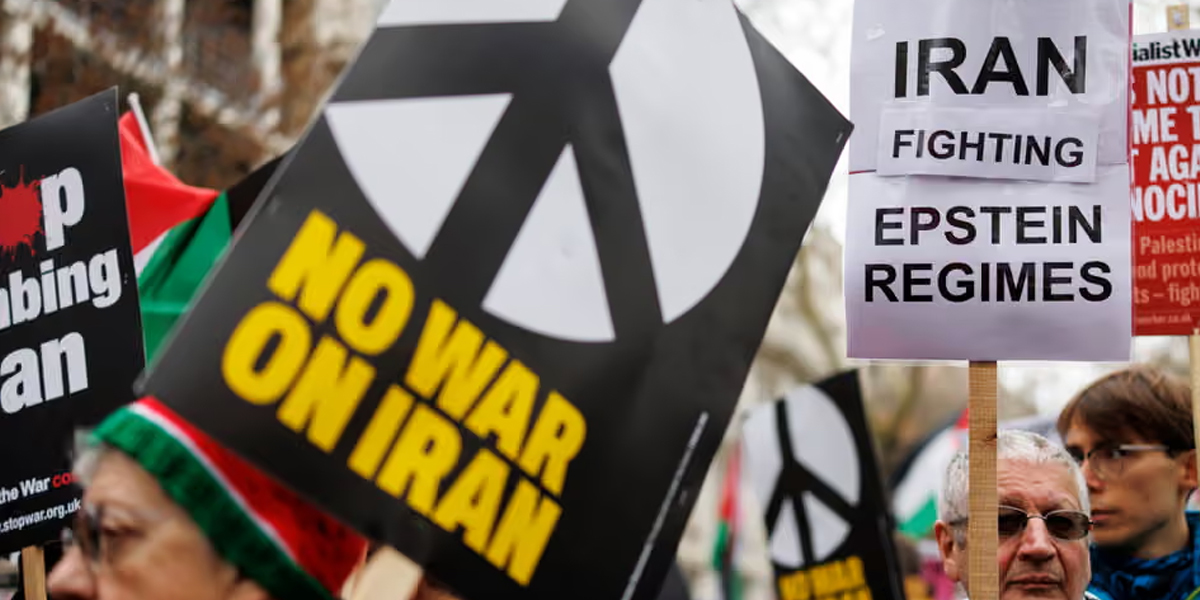
A major London protest against US Israel strikes on Iran saw thousands of demonstrators march through central London to the US embassy, demanding an end to military attacks on Iran and calling on the UK government not to support further escalation in the Middle East conflict.
Protest organisers said the demonstration brought together several anti-war and solidarity groups who gathered near Westminster before marching to the US embassy in Vauxhall on Saturday afternoon.
Participants carried Iranian and Palestinian flags, placards opposing military intervention, and banners condemning the latest strikes carried out by the United States and Israel.
The protest highlighted growing public concern in the UK about the expanding conflict in the Middle East and the potential for broader international involvement.
Protesters march from Westminster to US embassy
The march began at Millbank near the Houses of Parliament before moving toward the US embassy in south London.
Organisations involved in the demonstration included the Campaign for Nuclear Disarmament, Stop the War Coalition, the Palestine Solidarity Campaign, the Muslim Association of Britain, the Palestinian Forum in Britain and Friends of Al-Aqsa.
Many protesters carried signs reading “Stop the War on Iran”, “Stop Arming Israel”, “No War on Iran” and “Stop Trump’s Wars”.
Some demonstrators also held portraits of Iran’s former supreme leader Ayatollah Khamenei, who was reportedly killed in the initial strike that triggered the current escalation in the conflict last week.
According to a police officer accompanying the march, between 5,000 and 6,000 people took part in the demonstration.
Political speeches delivered outside the embassy
After reaching the US embassy in Vauxhall, speakers addressed the crowd calling for an end to military action and warning against British involvement in another war.
Your Party MP Zarah Sultana told demonstrators that public opposition to war must not be ignored.
She drew comparisons with the 2003 invasion of Iraq, when millions of people around the world protested against the US-led military campaign.
“Back then we were told that Iraq had weapons of mass destruction,” she told the crowd.
“We were told that war would bring peace and democracy and protect the world, but the truth was very different.”
Sultana said protesters had gathered again to ensure political leaders listened to public opposition to another military conflict.
Jeremy Corbyn message read to protesters
A statement from independent MP Jeremy Corbyn was read to demonstrators during the rally.
Corbyn, a former Labour leader, was unable to attend the event but sent a message expressing support for the protest.
The statement recalled the large demonstrations against the Iraq war in 2003 and urged the British government not to support further military intervention.
“In 2003, hundreds of thousands of us protested against the illegal invasion of Iraq and we were ignored,” the statement said.
“We are here today to say loudly and clearly: do not drag Britain into another illegal war.”
Corbyn also criticised what he described as the UK’s long-standing alignment with US foreign policy decisions.
Police make arrests during demonstration
The Metropolitan Police said several arrests were made during the protest.
Officers confirmed that a woman in her 60s was arrested on suspicion of inciting racial hatred in connection with a placard.
Later updates from police stated that three further arrests were made.
These included a person suspected of possessing an offensive weapon and another individual arrested for racially aggravated public order offences linked to a chant during the march.
A man in his 30s was also arrested on suspicion of violent disorder relating to a separate incident in Maida Vale the previous day.
Before the demonstration, the Metropolitan Police imposed conditions requiring the march to follow a designated route and conclude by 5pm.
Tensions between opposing demonstrators
Small groups of people carrying Israeli flags stood along Millbank as the march passed through central London.
Some protesters shouted “shame on you” and “murderers” toward the group, while counter-protesters responded with chants and remarks defending Israel.
Despite the tensions, the demonstration largely continued peacefully as it moved toward the embassy.
March leaders led chants including “Stop the bombing now” and “We are the people, we won’t be silenced”.
Protesters voice concerns about international law
Many participants said they joined the protest to oppose military intervention and what they see as violations of international law.
Daniela Costa, a Brazilian student living in London, said she attended to express solidarity with several countries affected by geopolitical tensions.
“I just came here to show solidarity, both to Iran and Palestine, but also to Cuba and Venezuela,” she said.
She added that public demonstrations could pressure governments to reconsider their involvement in international conflicts.
Another protester, Martin Perry from Northampton, said he believed the strikes against Iran violated international law.
“I’m here today to signal to the government that the public aren’t for the war against Iran,” he said.
Rising tensions in the Middle East
The London protest against US Israel strikes on Iran comes amid escalating tensions in the Middle East following military action targeting Iranian infrastructure and leadership.
The region remains central to global geopolitics due to its strategic position, energy resources and longstanding political rivalries.
Recent military exchanges have raised fears of a wider regional conflict involving multiple countries.
Anti-war groups in the UK have historically organised large demonstrations during periods of international conflict, including the mass protests against the Iraq war in 2003.
Organisers of the latest march said they plan to hold additional demonstrations in the coming weeks, including a rally scheduled for 28 March in central London aimed at opposing the far right and promoting peace campaigns.
Growing anti-war activism in the UK
Public protests have often played a significant role in shaping debate around British foreign policy.
Campaign groups argue that demonstrations allow citizens to voice concerns about military intervention and international alliances.
As tensions continue in the Middle East, activists say they expect further demonstrations across the UK calling for diplomacy and de-escalation.