
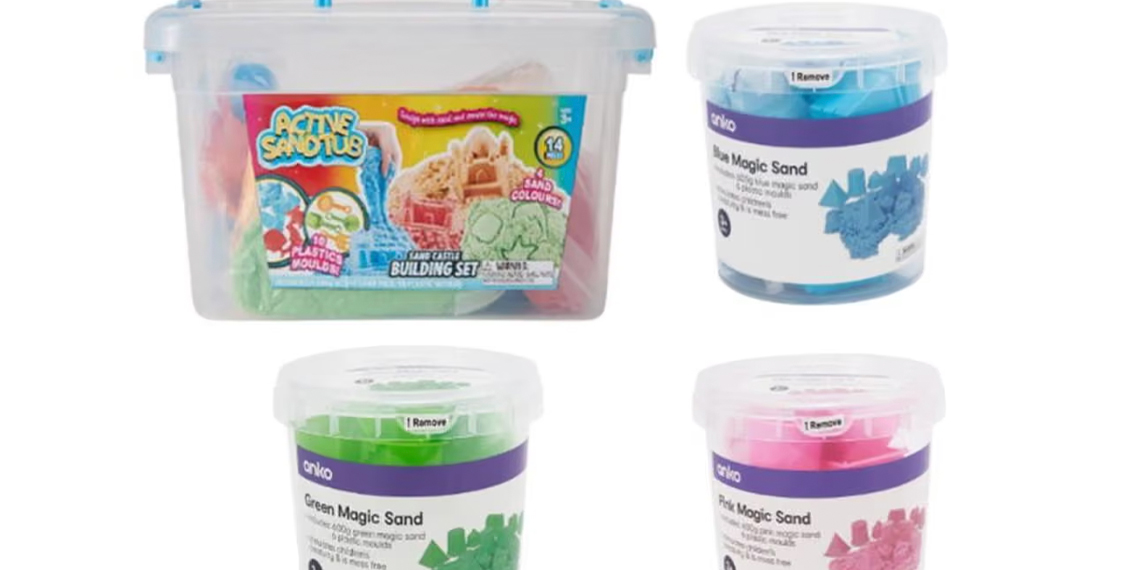
More than 30 children’s toys have been recalled across the UK after dangerous traces of asbestos were discovered in play sand products, raising serious concerns about product safety standards and regulatory oversight.
The recalls follow an investigation that revealed contaminated sand in craft kits sold by Hobbycraft, prompting a wider review of similar products stocked by major retailers including Tesco, Primark, Matalan and Marks & Spencer.
Asbestos Discovery Triggers Nationwide Recalls
The issue came to light earlier this year when a customer alerted Hobbycraft to the presence of asbestos in coloured sand included in one of its popular craft kits. The company quickly withdrew the product and launched a national recall, advising customers to safely seal and dispose of the affected materials.
Further testing has since uncovered similar contamination in a range of children’s toys, including candle-making kits and stretchy rubber products. Many of these items are believed to contain sand sourced from regions in China where asbestos fibres can occur naturally.
Under UK law, asbestos is strictly banned in consumer products due to its well-established links to serious diseases, including cancer, when inhaled.
Surge in Testing Exposes Wider Safety Concerns
Following the initial findings, the Office for Product Safety and Standards issued updated guidance on more reliable testing methods, leading to a surge in checks by manufacturers and retailers.
These enhanced tests revealed that some products previously certified as safe were in fact contaminated, highlighting potential shortcomings in earlier screening processes.
Consumer advocacy group Which? warned that the growing number of recalls suggests a systemic failure in safety controls, calling for stronger oversight and enforcement.
Retailers and Authorities Under Pressure
Campaigners have criticised the UK government for what they describe as a slow response, particularly given that similar contamination issues had already prompted recalls and school closures in countries such as Australia and New Zealand.
Despite those earlier warnings, affected products remained available in UK stores and online marketplaces for months, raising questions about supply chain monitoring and regulatory coordination.
Experts have also raised concerns about the sale of potentially hazardous toys through online platforms, where safety checks are often less rigorous than in traditional retail environments.
Post-Brexit Rules Shift Responsibility to Companies
Changes to UK product safety regulations following Brexit have placed greater responsibility on manufacturers and retailers to ensure their goods meet safety standards.
Unlike previous frameworks, authorities now rely more heavily on companies to identify and report hazards, rather than proactively banning products without conclusive scientific evidence.
The government has defended its approach, stating that businesses are required to act swiftly when risks are identified and to remove unsafe products from sale.
Health Risks and Public Safety Concerns
Asbestos exposure remains a major public health concern, with long-term health risks including lung cancer and other serious respiratory conditions. Even small quantities can pose dangers if fibres are inhaled, particularly by children.
The discovery of asbestos in toys has intensified calls for tighter import controls, improved testing standards, and clearer labelling requirements to prevent similar incidents in the future.
Growing Calls for Stronger Consumer Protection
With dozens of recalls already issued, pressure is mounting on regulators and policymakers to strengthen safeguards and restore public confidence in product safety.
Consumer groups argue that more proactive testing, stricter enforcement, and closer international cooperation are needed to ensure that hazardous materials do not enter the UK market.
The incident has also reignited debate over the effectiveness of current regulatory frameworks, particularly in the context of global supply chains and evolving safety risks.