
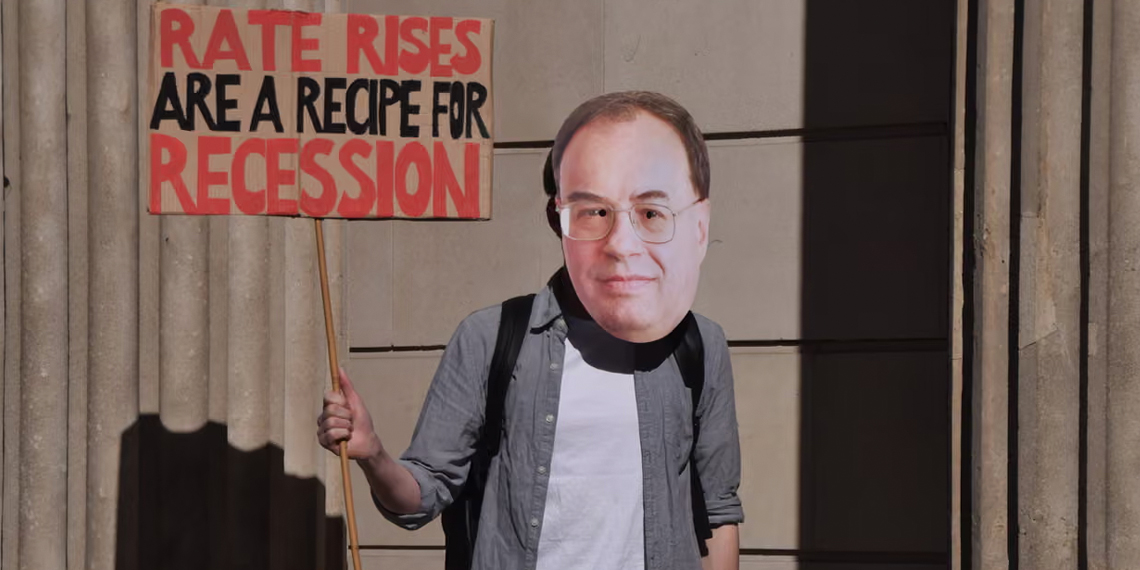
The Bank of England has kept interest rates unchanged at 3.75%, but warned that the UK economy may face further pressure ahead, stating that “higher inflation is unavoidable” following rising global energy costs linked to the war in the Middle East.
The Monetary Policy Committee (MPC), the Bank’s rate-setting body, voted 8–1 to hold rates steady on Thursday. It marked a pause in a cycle of cuts that has seen borrowing costs reduced six times since mid-2024.
Governor Andrew Bailey said the conflict in the Middle East is already feeding through into the UK economy, pushing inflation higher.
He said the Bank of England is monitoring global risks “very closely”, adding that holding rates at 3.75% was a “reasonable decision given economic uncertainty and instability in the Middle East”.
The MPC’s primary goal is to return UK inflation to its 2% target. However, the Bank acknowledged that the outlook has shifted significantly since earlier this year, when inflation was expected to fall back to target levels.
Latest figures from the Office for National Statistics (ONS) show UK inflation rose to 3.3% in March, up from 3% in February, driven largely by higher energy prices.
The Bank of England warned that rising oil and gas costs are already increasing fuel and household energy bills, with further inflationary pressure expected as these costs continue to feed through the economy.
However, policymakers said second-round effects, such as wage-driven inflation, may be limited. The Bank pointed to weaker demand in the UK economy, rising unemployment since 2024, and subdued consumer confidence as factors restricting price growth.
It noted that current conditions differ from the 2022 energy crisis triggered by the Russia–Ukraine war, as inflation and demand are now comparatively weaker and monetary policy remains restrictive.
The only dissenting vote came from Huw Pill, the Bank’s Chief Economist, who argued for an increase in rates to 4%.
He warned that the risk of inflation becoming embedded in wages and prices is tilted to the upside, potentially leading to more persistent inflation pressures in the UK economy.
The Bank of England also set out three potential scenarios for the UK economy depending on how the Iran conflict affects global energy markets.
In all scenarios, inflation is expected to rise and unemployment could reach at least 5.5%.
In its most severe projection, where oil prices rise to $130 a barrel and remain elevated, inflation could peak at 6.2% in early 2027. Under that scenario, interest rates could climb to 5.25% before easing later.
A more moderate scenario assumes oil prices peak at $108 a barrel before falling below $80 by 2027. In this case, inflation would gradually decline to 1.5% by 2028.
Another scenario sees oil prices remaining higher for longer, keeping inflation closer to 3% in 2027 before easing towards 2% by 2028.
Brent crude briefly reached a four-year high of $126 a barrel earlier in the day before falling back to around $115.50.
The decision to hold interest rates steady is likely to ease pressure on the UK Government ahead of upcoming local elections.
Chancellor Rachel Reeves has already introduced measures aimed at easing inflation, including cuts to household energy bills and a rail fare freeze, both introduced in April.
Economic data had previously shown signs of resilience, with UK GDP growing by 0.5% in the three months to February and unemployment falling to 4.9%, although economists warn that rising global energy costs could weaken this momentum.
The Bank of England’s latest guidance signals that while interest rates are on hold for now, the risk of further inflationary pressure means UK borrowers may not be seeing cuts again any time soon.