
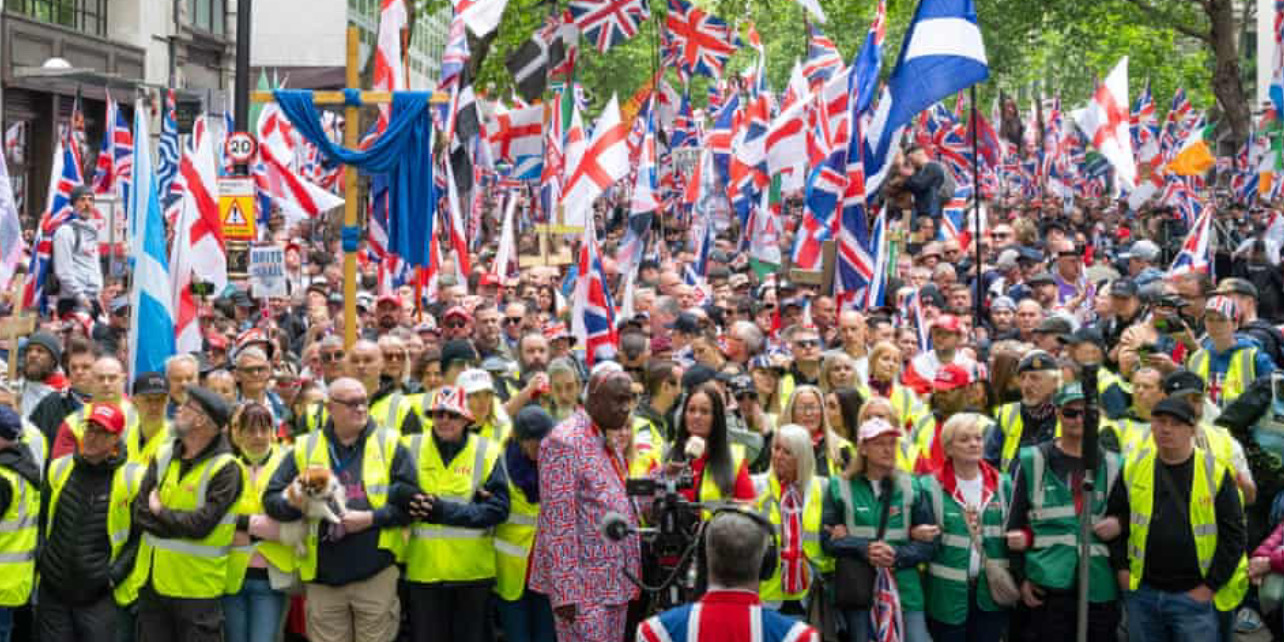
Police arrested 43 people during two major demonstrations in central London after supporters of Tommy Robinson’s Unite the Kingdom rally and pro-Palestinian protesters gathered in the capital under heavy security operations led by the Metropolitan Police.
Authorities said the far-right Unite the Kingdom rally, organised by Robinson — whose real name is Stephen Yaxley-Lennon — attracted significantly fewer people than a similar protest held last year, despite organisers hoping for turnout figures in the hundreds of thousands.
The protests took place alongside a large pro-Palestinian march through London, prompting one of the biggest policing operations mounted in the city in recent years.
According to police estimates, about 60,000 people attended the Unite the Kingdom rally on Saturday, far below the estimated 150,000 who joined Robinson’s demonstration in September last year. Organisers had reportedly hoped the event would attract more than one million participants.
At the same time, police estimated the pro-Palestinian demonstration drew between 15,000 and 20,000 people, although organisers claimed attendance reached 250,000.
Metropolitan Police Confirm 43 Arrests Across London Demonstrations
The Metropolitan Police said 43 arrests were made during the protests and related events across London.
Police confirmed that 20 arrests were linked to the Unite the Kingdom rally, including nine involving alleged hate crimes.
Another 12 arrests were connected to the pro-Palestinian demonstration, including two related to alleged hate offences.
The remaining 11 arrests were not directly linked to either protest group.
Authorities said five police officers were allegedly assaulted during the demonstrations, although none required hospital treatment.
The large-scale operation involved around 4,000 police officers, including personnel brought in from other police forces across the UK.
Officials described the operation as one of the largest public order policing deployments in London in recent years.
Alleged Hate Crime Incidents Reported at Unite the Kingdom Rally
Police said several individuals attending the Unite the Kingdom rally were arrested following allegations of racist, religious or homophobic abuse directed at officers.
One officer from an ethnic minority background was allegedly told to “go back home,” while two officers reportedly faced homophobic insults.
Another officer was allegedly subjected to religious abuse.
Police also said two suspects already under arrest for separate offences allegedly used racist language, including the N-word, against officers.
Additional arrests were made over placards displayed during the rally, including signs carrying anti-Islam slogans.
One woman was arrested near Whitehall after police allegedly found her carrying a sword approximately three feet long.
Witnesses said the woman appeared to be dressed in a historical English military-style costume and cooperated with officers during the arrest.
Another incident involved a man accused of assault after allegedly boarding a coach transporting pro-Palestinian demonstrators and punching a passenger after being asked to leave.
Tommy Robinson Rejects Far-Right Label
Speaking on stage during the Unite the Kingdom event, Robinson rejected accusations that the movement was far-right.
“We are a cultural movement,” he told supporters.
The rally included strong Christian imagery and symbolism, including crosses and public recitations of the Lord’s Prayer.
Robinson has previously spoken publicly about converting to Christianity after serving time in prison last year.
Crowds at the rally repeatedly chanted “Christ is king,” while organisers promoted the demonstration as a defence of British identity and culture.
Police said tensions between officers and protesters appeared lower than during Robinson’s previous London protest in September, when more than 20 officers were allegedly assaulted.
Investigators are still seeking more than 50 suspects connected to offences linked to last year’s demonstration.
Pro-Palestinian Protest Also Under Investigation
Several arrests were also made during the pro-Palestinian demonstration, including over signs and slogans police believed could breach UK laws on hate speech or support for banned organisations.
One individual was arrested for displaying a sign reading “Globalise the intifada,” which police allege could be interpreted as support for violence against Jewish people.
Another arrest involved a placard expressing support for Palestine Action, which is subject to legal restrictions in the UK.
A third person was detained over a sign stating: “We will not surrender, victory or martyrdom.”
The Metropolitan Police said officers are continuing to examine seven videos featuring chants and written slogans to determine whether any criminal offences involving antisemitic hate speech were committed.
The force has faced criticism from some campaign groups and activists who argue police restrictions risk limiting legitimate political protest and freedom of expression.
Tight Security Measures Across Central London
Police imposed strict conditions on both demonstrations, including designated routes, monitored speeches and close surveillance of public activity.
Authorities monitored speeches from stages at both events to identify potential criminal offences.
One controversial stunt at the Unite the Kingdom rally involved three individuals appearing on stage dressed in burqas before revealing themselves to be white women.
Police later concluded that the incident did not meet the criminal threshold for prosecution.
The demonstrations also took place on the same day as the FA Cup final at Wembley Stadium, placing additional pressure on policing resources across London.
Police confirmed that 22 arrests were also made during football-related operations connected to the FA Cup final.
Rising Political Tensions in Britain
Saturday’s protests highlighted growing political and social divisions in the UK surrounding immigration, national identity, religion and the war in Gaza.
Pro-Palestinian demonstrations have continued regularly across Britain since the outbreak of the Israel-Gaza conflict, drawing large crowds and increasing political pressure on the UK government.
At the same time, anti-immigration and nationalist groups have attempted to mobilise support through rallies focused on border security, crime and cultural identity.
Tommy Robinson remains one of Britain’s most controversial political activists and has frequently attracted criticism over alleged extremist rhetoric and anti-Muslim campaigning.
Meanwhile, police forces across the UK continue facing increasing scrutiny over how they manage politically sensitive demonstrations involving competing protest groups.
Despite the arrests and isolated incidents, the Metropolitan Police said both demonstrations concluded without major disorder.
A spokesperson for the force said the events had “passed off without any significant incidents” given the scale of the crowds and the complexity of the operation.