
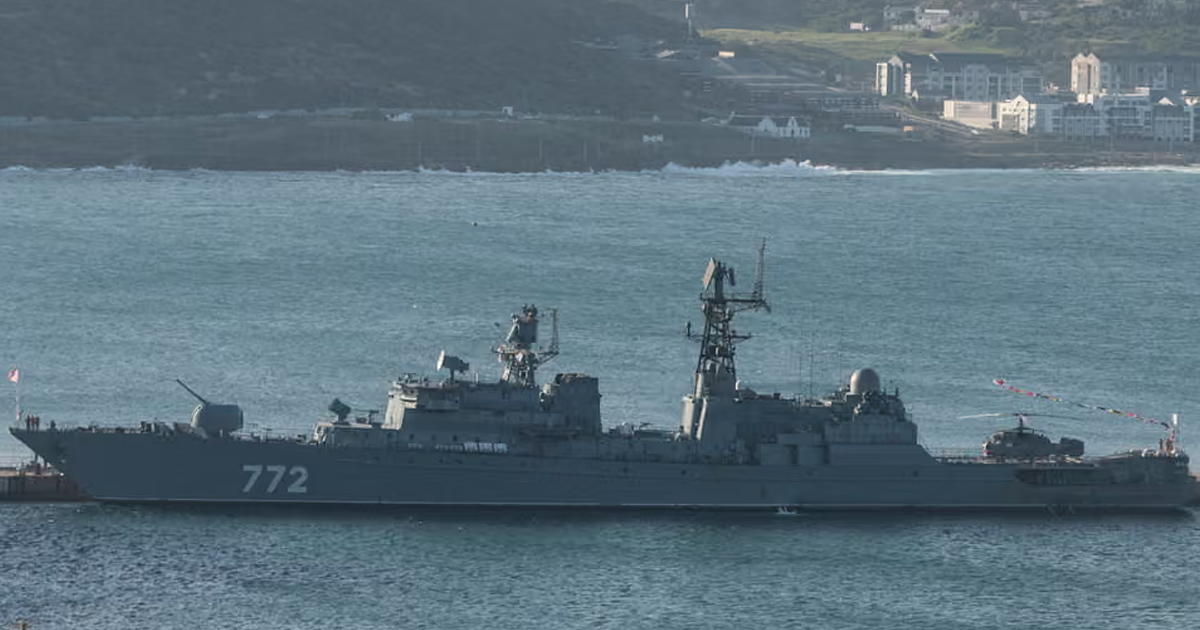
A Russian naval frigate conducted an uncommon live-fire exercise approximately 45 miles south of Plymouth on Monday, prompting renewed scrutiny of Moscow’s military activities near the United Kingdom. The exercise, which took place in international waters, was carried out with little advance notice and required the Royal Navy to reposition one of its patrol vessels to ensure operational safety.
The warship, identified as the Neustrashimy, informed British authorities on Monday morning that it intended to carry out a live gunnery exercise using its primary naval gun. In accordance with established maritime safety procedures, the Russian vessel requested that the Royal Navy patrol ship shadowing its movements withdraw to a safer distance before the exercise commenced.
The British offshore patrol vessel HMS Tyne, which had been monitoring the frigate’s transit through nearby waters, moved approximately five miles away, enabling the Russian vessel to complete its scheduled firing drill. The exercise reportedly lasted around 30 minutes and began at approximately 9:30 a.m. in international waters south of the British coastline.
UK Government Criticises Exercise as Provocative
The incident quickly drew criticism from senior British officials, who characterised the manoeuvre as an unnecessary demonstration of military power during a period of heightened geopolitical tensions.
UK Defence Secretary Wes Streeting described the exercise as “performative and irresponsible,” arguing that it reflected broader security challenges confronting Britain and its allies. Speaking shortly after the incident, Streeting said the drill highlighted the increasingly complex threat environment facing the United Kingdom, emphasising that such military displays form part of a wider pattern of strategic pressure from Russia.
The live-fire exercise coincided with a significant political transition in Britain, taking place on the same day that Andy Burnham assumed office as the country’s new prime minister.
Rare Exercise Conducted Near One of the World’s Busiest Shipping Routes
Although international maritime law permits live-fire naval exercises in international waters provided adequate safety warnings are issued, military analysts note that conducting such operations with limited notice in close proximity to another nation’s coastline remains highly unusual.
British defence officials indicated they could not recall another instance in recent years in which a Russian warship had fired its weapons so close to the UK mainland.
The location of the exercise is particularly significant because it lies near the English Channel, one of the busiest commercial shipping corridors in the world. Naval authorities generally exercise exceptional caution when conducting weapons testing in the region to minimise disruption to civilian maritime traffic and ensure navigational safety.
Neustrashimy Equipped with Advanced Naval Weapons
The Neustrashimy is a heavily armed Russian frigate measuring approximately 130 metres in length. Its principal weapon is a 100mm naval cannon capable of firing up to 50 rounds per minute at targets located as far as 20 kilometres away.
Beyond its primary artillery system, the vessel is equipped with anti-ship cruise missiles designed to engage surface combatants at long range. It also carries Gatling-style rotary guns integrated into its close-range air defence systems, providing protection against aircraft, drones, and incoming missiles.
The frigate has been operating near British waters throughout July after replacing another Russian warship, the Admiral Grigorovich, which had spent approximately three months patrolling areas including the English Channel and the North Sea.
Continued Russian Naval Presence Around the UK
Russian naval activity around the British Isles has increased considerably throughout 2026, with several deployments drawing close attention from the Royal Navy.
Last month, another Russian frigate—the Admiral Grigorovich—made headlines after firing warning shots while operating near a British pleasure yacht south of the Isle of Wight. The incident reportedly occurred within only a few hundred metres of the civilian vessel, raising further concerns about maritime safety and regional stability.
Military analysts suggest that Russia’s sustained naval deployments around the UK serve multiple strategic purposes. In some instances, warships have escorted oil tankers associated with Russia, while in other cases their presence appears intended to project military influence, gather intelligence, and compel Britain to dedicate naval assets to persistent surveillance operations.
Maintaining continuous monitoring of Russian vessels places additional operational demands on the Royal Navy, requiring ships and personnel to remain on extended patrols as Russian warships transit through waters surrounding the British Isles.
Royal Navy Continues Close Monitoring
Following completion of the firing exercise, the Neustrashimy continued sailing eastward, passing to the east of the Isle of Wight on Tuesday morning. Defence officials believe the frigate is likely heading toward the North Sea, where it may undertake logistical operations, including refuelling.
Responsibility for tracking the Russian vessel has now transferred from HMS Tyne to HMS Mersey, ensuring uninterrupted surveillance as the frigate continues its voyage.
The UK’s Ministry of Defence confirmed that the Royal Navy observed the live-fire exercise throughout its duration and continues to monitor the vessel’s movements closely.
A ministry spokesperson stated that the Russian naval vessel, while under Royal Navy surveillance, conducted its live-fire weapons exercise approximately 40 nautical miles south of Plymouth in international waters. Officials added that British naval forces remain fully prepared to safeguard national security and respond appropriately to any developments affecting UK territorial interests.
Maritime Tensions Between the UK and Russia Continue to Escalate
The latest naval incident comes amid deteriorating maritime relations between London and Moscow.
Last month, Royal Marines seized a Russia-linked oil tanker in the English Channel, an operation that prompted speculation about possible retaliatory measures from Moscow. Since then, analysts have warned that increased Russian naval activity around British waters could represent both a strategic signal and an effort to test NATO surveillance and response capabilities.
The Kremlin has maintained that Russian naval operations fully comply with international maritime law. Kremlin spokesperson Dmitry Peskov stated that Russian warships consistently operate “in strict accordance” with applicable legal frameworks governing international waters.
When asked whether relations between Moscow and the United Kingdom might improve under Britain’s newly appointed prime minister, Peskov dismissed the prospect, stating that the Russian government had “no such hopes.”
The latest live-fire exercise underscores the increasingly tense security environment surrounding northern European waters, with both the Royal Navy and Russian naval forces maintaining a visible and sustained presence as geopolitical friction between the two countries continues.