
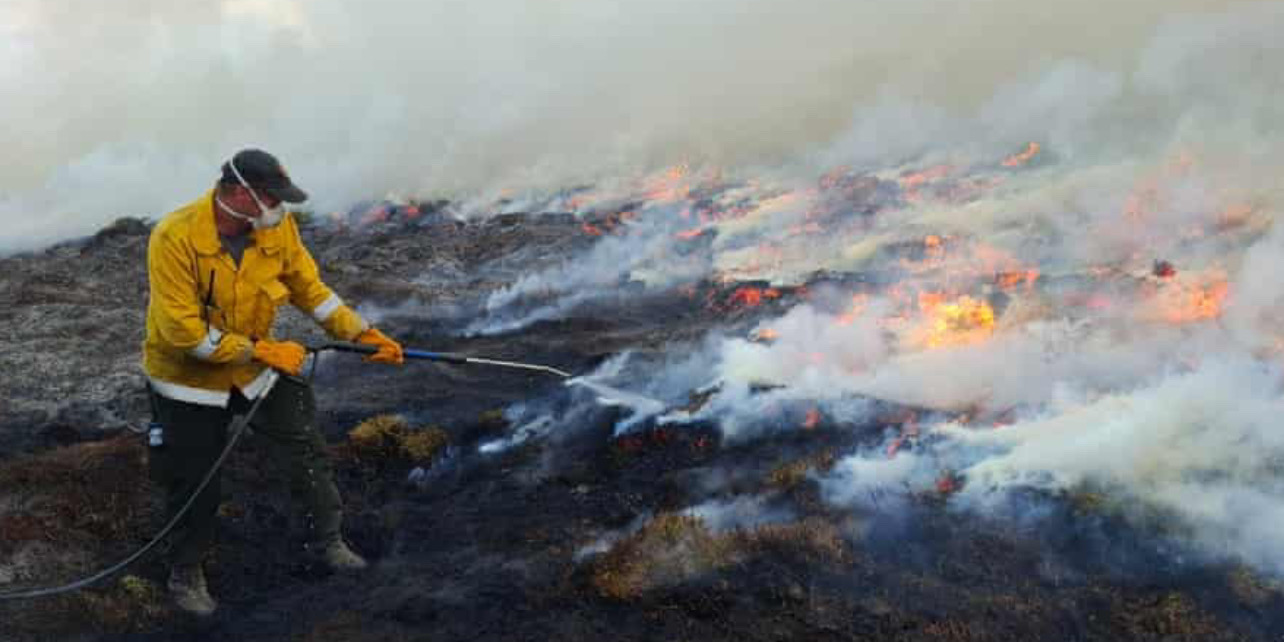
A major incident has been declared in Scotland after a rapidly intensifying wildfire in the Cairngorms National Park forced the evacuation of the entire village of Nethy Bridge. Emergency services took the precautionary measure following a dramatic deterioration in weather conditions, with strengthening winds accelerating the spread of the blaze and significantly complicating efforts to bring it under control.
The wildfire, which has burned continuously for more than 11 days, has become one of the most significant wildfire emergencies to affect the Scottish Highlands in recent years. Authorities warned that shifting wind patterns have increased the threat to nearby communities, prompting immediate action to protect residents and critical infrastructure.
Police Scotland confirmed that deteriorating conditions had led officials to declare a major incident, enabling emergency services and government agencies to coordinate an expanded response as firefighters continue battling the fast-moving blaze.
Residents Relocated as Fire Advances Towards Village
Residents of Nethy Bridge were evacuated and transferred to a dedicated respite centre established at the Macdonald Aviemore Hotel after authorities concluded that the advancing wildfire posed a potential risk to the village.
Access roads into the area were closed to facilitate emergency operations and ensure public safety, while emergency planners closely monitored the fire’s movement. Officials stressed that the evacuation was undertaken as a precautionary measure, with public safety remaining the highest priority as unpredictable weather conditions continue to influence the fire’s behaviour.
The Scottish Government has urged residents to comply fully with emergency instructions while firefighters work to establish containment lines designed to prevent the flames from reaching populated areas.
Scottish Government Mobilises Emergency Response
The escalating crisis prompted the Scottish Government’s Resilience Room (SGoRR) to convene an emergency meeting chaired by First Minister John Swinney. The session brought together senior ministers, emergency service leaders and resilience officials to coordinate Scotland’s response to the growing wildfire emergency.
Addressing the situation, Swinney said changing wind conditions had substantially accelerated the wildfire’s rate of spread, increasing the complexity of firefighting operations across the Cairngorms National Park.
He praised the efforts of emergency responders who have been working continuously since the fire was first reported and confirmed that the Scottish Fire and Rescue Service (SFRS) is concentrating significant resources on constructing firebreaks intended to slow the wildfire’s advance.
The First Minister also confirmed that he remains in regular contact with emergency agencies and that the Scottish Government’s resilience team will continue to meet as the situation develops.
Firefighters Continue Battle Across Challenging Terrain
The wildfire first ignited near the village of Glenmore on 15 July before rapidly expanding across large sections of the national park. At its peak, the fire affected approximately six square kilometres of heather, woodland and surrounding vegetation, creating an extensive wildfire front across one of Scotland’s most environmentally significant landscapes.
More than 500 firefighters have been deployed during the emergency, supported by specialist wildfire response units, all-terrain vehicles, helicopter water-bombing operations and a range of partner organisations.
Emergency officials said crews continue to operate under exceptionally demanding conditions across remote and rugged terrain. Firefighters are working alongside Forestry and Land Scotland, the Cairngorms National Park Authority, local landowners, estate gamekeepers and additional emergency service partners.
Authorities emphasised that the expertise and local knowledge provided by these organisations have proved invaluable in navigating the complex geography of the national park and supporting ongoing containment efforts.
Weather Conditions Fuel Rapid Fire Spread
Police Scotland said the weather over the previous 24 hours had dramatically altered the operational picture, with stronger winds driving the wildfire closer to Nethy Bridge and increasing the urgency of the response.
Superintendent Judy Hill stated that evidence indicated the fire was advancing towards the village, making evacuation the most appropriate precautionary course of action. She noted that the evolving weather conditions had introduced additional challenges for emergency crews attempting to contain the blaze safely.
Wildfires remain highly sensitive to changing has generated a substantial smoke plume that has affected communities well beyond the immediate fire zone. Earlier in the incident, changing wind conditions carried wind direction, temperature and humidity, all of which can rapidly alter fire behaviour and complicate firefighting operations.
Smoke Impacts Communities Across the Highlands
The wildfire has generated a substantial smoke plume that has affected communities well beyond the immediate fire zone. Earlier in the incident, changing wind conditions carried smoke approximately 97 kilometres (60 miles) to Aberdeen, highlighting the extensive environmental impact of the blaze.
On Saturday, the Scottish Fire and Rescue Service also issued a public health advisory for residents in Tomintoul, located roughly 16 kilometres east of Nethy Bridge. Residents were urged to keep windows and doors closed to minimise exposure to smoke as air quality deteriorated.
Officials continue to monitor smoke movement closely, warning that changing weather conditions could affect additional communities if the wildfire remains active.
Emergency Services Continue Containment Operations
Firefighters remain focused on preventing further expansion of the wildfire while protecting nearby settlements and vital natural habitats within the Cairngorms National Park. Helicopter water drops, specialist firefighting equipment and strategically positioned firebreaks remain central to the ongoing containment strategy.
Authorities continue to assess the wildfire’s progression in real time, with emergency planners maintaining close coordination across multiple agencies. While no timeline has been provided for residents to return to Nethy Bridge, officials have pledged to review the evacuation order as soon as conditions permit.
As firefighting operations continue, emergency services have urged the public to avoid restricted areas, follow official updates and cooperate fully with evacuation measures designed to safeguard lives during one of Scotland’s most significant wildfire incidents in recent memory.