
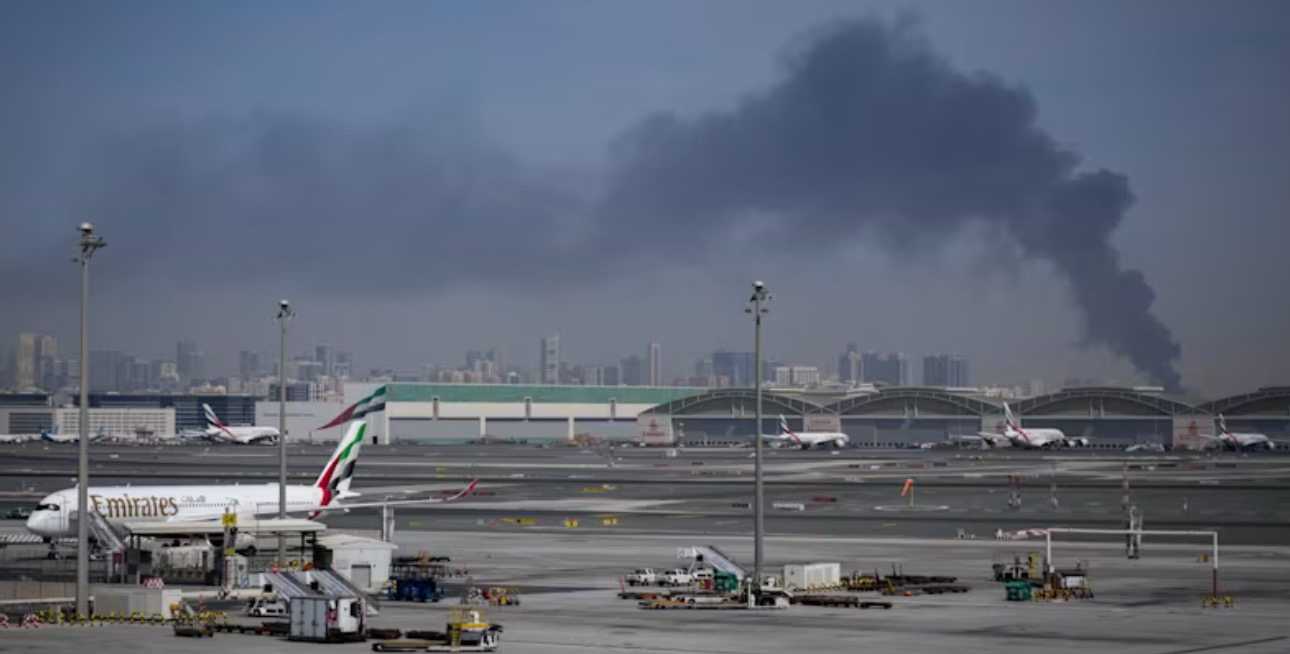
British nationals are among thousands of travellers stranded in Dubai and across the Gulf after major airports were forced to suspend operations following retaliatory missile strikes by Iran.
Airspace across parts of the Middle East was closed after the United States and Israel launched airstrikes on Iranian cities, including Tehran. Iran responded with missile attacks targeting regional locations. Iran’s Supreme Leader, Ali Khamenei, was later confirmed dead in the assault.
The disruption continued into Sunday, with airlines suspending flights and airports in the United Arab Emirates, Qatar and neighbouring states facing widespread cancellations.
Dubai, a major holiday hotspot for UK tourists and home to thousands of British expats, has been particularly affected.
Emirates said in a statement on X: “Due to multiple regional airspace closures, Emirates has temporarily suspended all operations to and from Dubai, up until 3pm UAE time on Monday March 2.”
The airline advised passengers due to travel on or before March 5 to rebook on an alternative flight or request a refund.
Etihad Airways also confirmed disruption, stating: “Regional airspace closures continue to impact Etihad’s operations, and all flights to and from Abu Dhabi are suspended until 2am UAE time on Monday March 2.”
Passengers have been urged to check flight status before travelling to the airport and ensure their booking details are updated. Refunds are available for certain affected dates.
Qatar Airways said flights remained temporarily suspended due to the closure of Qatari airspace.
According to aviation analytics firm Cirium, 83 flights were still scheduled to operate between the UK and the Middle East on Sunday, though further disruption remains possible.
British holidaymakers caught up in the crisis described a tense atmosphere.
Kirsty Greyling, who is in Dubai with her toddler, told ITV News the situation was “terrifying”. She said the “vibe was quite fraught” in the city and described being in a restaurant opposite the Fairmont The Palm hotel when it was struck following retaliatory missile fire.
She and other guests slept in the basement of their hotel overnight as a precaution.
“The vibe is fraught but we do feel safe inside the hotel,” she said.
“We can’t go outside the hotel… you can hear the odd missile in the background.”
Four people were injured at Dubai International Airport after what the UAE government described as a “blatant attack involving Iranian ballistic missiles”.
At Zayed International Airport in Abu Dhabi, one person was killed and seven others injured in a drone strike. Strikes were also reported near Kuwait International Airport.
The Foreign, Commonwealth and Development Office (FCDO) has urged British nationals in Bahrain, Israel, Palestine, Qatar and the United Arab Emirates to register their presence to receive updates.
In a statement posted on X, the department said: “British nationals in Bahrain, Israel, Palestine, Qatar and United Arab Emirates can register their presence to receive direct updates from the FCDO on the situation in the Middle East.
“You should continue to follow travel advice and the advice of the local authorities.”
With regional tensions high and airspace restrictions still in place, thousands of UK travellers remain uncertain about when they will be able to return home.