
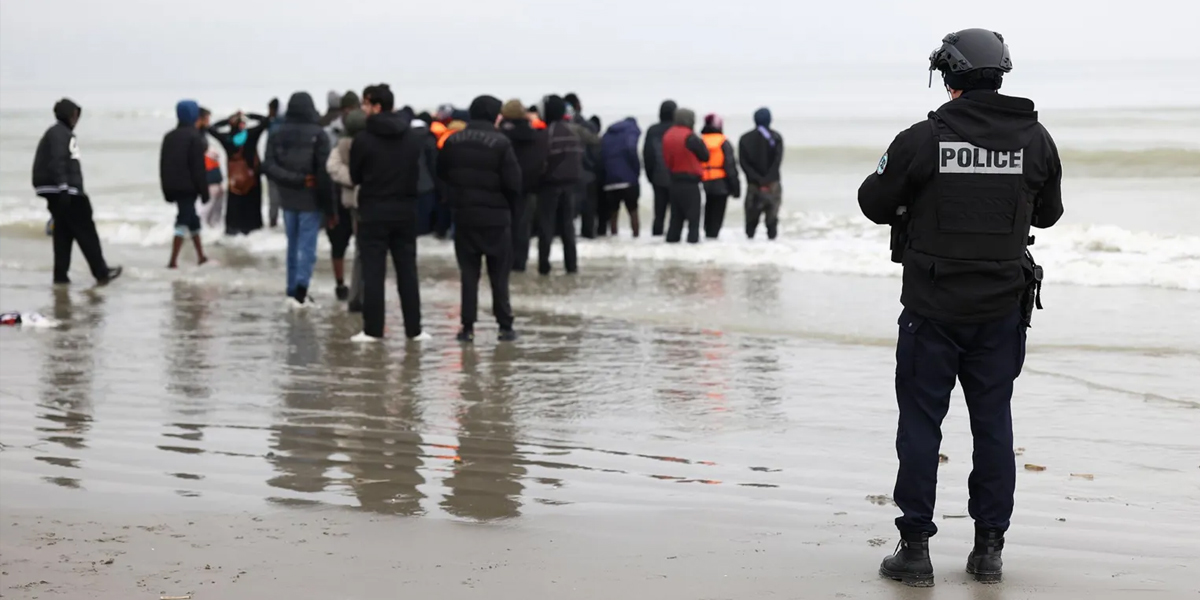
The new UK-France migrant deal aims to curb illegal Channel crossings through a £662 million three-year agreement that will see riot-trained police deployed on French beaches, alongside drones, helicopters, and enhanced surveillance systems targeting people-smuggling networks.
The agreement, signed by Shabana Mahmood and French Interior Minister Laurent Nunez, marks a significant escalation in joint enforcement efforts between United Kingdom and France to tackle illegal migration across the English Channel.
Riot police and surveillance tools to target crossings
Under the UK-France migrant deal, at least 50 officers trained in riot and crowd control tactics will be deployed to northern French beaches, where tensions between migrants and law enforcement have previously escalated.
The operation will also include advanced technology such as drones, helicopters, and camera systems designed to track and intercept migrants and disrupt smuggling gangs before boats reach the water.
Officials say the measures are intended to address increasingly organised and adaptive trafficking networks, which have driven a surge in small boat crossings in recent years.
The Home Office confirmed that enforcement efforts will expand significantly, with the number of personnel involved rising to nearly 1,100 officers, including law enforcement, intelligence, and military staff.
Funding linked to performance targets
For the first time, the agreement introduces conditional funding, allowing the UK to withdraw or redirect up to £100 million if the measures fail to significantly reduce crossings after one year.
While specific targets have not been publicly disclosed, the performance-based funding reflects growing political pressure to deliver measurable results.
The deal allocates £501 million to frontline enforcement, with an additional £160 million contingent on the success of new tactics aimed at reducing migrant journeys.
Dunkirk removal centre and deportation strategy
A key component of the agreement is the planned completion of a migrant removal centre in Dunkirk, expected to be operational by the end of the year. The facility will have capacity for 140 individuals and will be staffed by more than 200 officers.
The centre will focus on deporting migrants from countries including Eritrea, Afghanistan, Iran, Sudan, Somalia, Ethiopia, Iraq, Syria, Vietnam, and Yemen—identified as the main nationalities involved in Channel crossings.
Authorities say the centre will streamline deportation processes and reduce the number of repeat crossing attempts.
Rising Channel crossings drive urgency
The UK-France migrant deal comes amid a sustained rise in small boat crossings. In 2025, more than 41,000 migrants arrived in the UK via the Channel, while over 6,000 have already arrived in 2026.
Recent data shows that 602 migrants reached Dover in a single day, highlighting the scale of the challenge facing authorities.
Crossings are influenced by weather conditions and enforcement levels, but experts say the persistence of smuggling networks and lack of legal migration routes continue to drive demand.
France has defended its approach, stating that its police focus on intercepting boats at sea to prevent dangerous overcrowding and reduce the risk of fatalities.
Political divisions over migration strategy
The deal has sparked political debate in the UK, with opposition parties questioning its effectiveness and value for money.
Critics argue that previous agreements have failed to significantly reduce crossings, despite substantial financial investment. Others have called for broader reforms, including changes to asylum laws and international agreements such as the European Convention on Human Rights.
Meanwhile, some policymakers and advocacy groups stress that enforcement alone cannot solve the crisis, pointing to the need for safe and legal migration routes.
The Refugee Council has warned that without alternative pathways, vulnerable individuals will continue to risk dangerous journeys across the Channel.
Ongoing UK-France cooperation on migration
The latest UK-France migrant deal builds on a previous £476 million agreement signed in 2023, which funded additional patrols and surveillance measures along the French coastline.
That earlier deal deployed around 700 officers and included monitoring systems to measure progress, though critics say it delivered limited success in reducing crossings.
In parallel, the UK and France have introduced a “one-in-one-out” scheme, allowing some migrants arriving in the UK to be returned to France while accepting others through legal routes.
Despite these measures, migration across the Channel remains a complex and evolving issue, driven by global conflicts, economic instability, and demand for asylum in Europe.
Experts warn that long-term solutions will require a combination of enforcement, international cooperation, and policy reform to address the root causes of migration.