
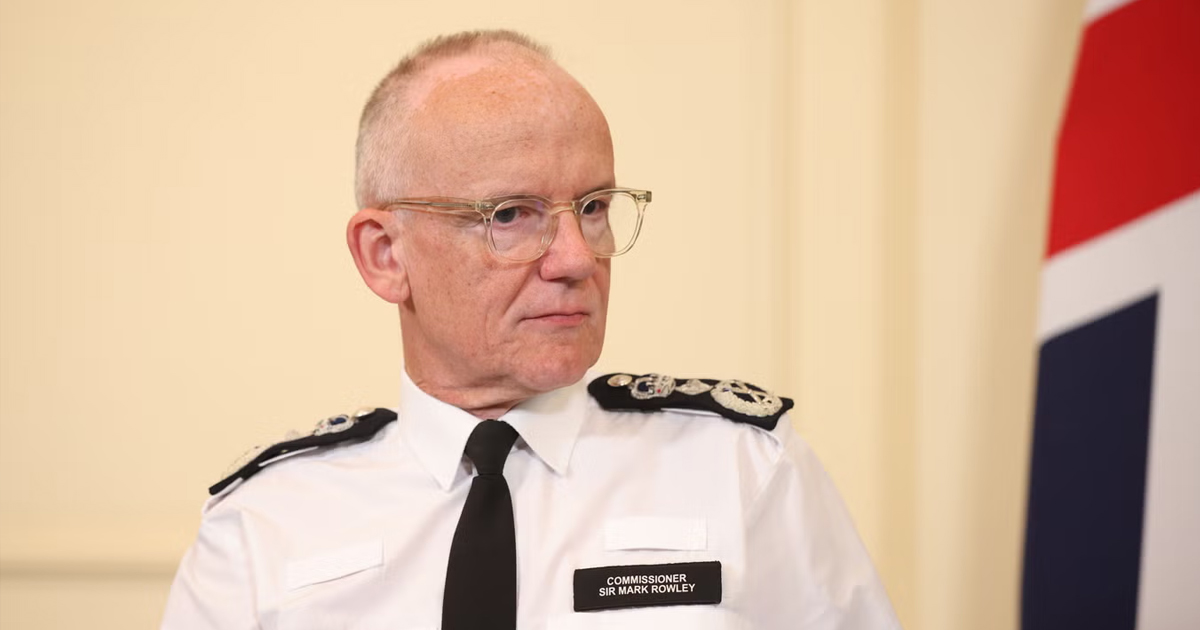
The Palestine Coalition has demanded that the head of the Metropolitan Police, Sir Mark Rowley, retract claims that pro-Palestinian protest organisers have repeatedly attempted to route marches past synagogues in London, describing the allegations as “incomprehensible and defamatory”.
The coalition, which includes groups such as the Palestine Solidarity Campaign and Stop the War Coalition, sent a formal letter to Sir Mark rejecting his remarks and insisting they are inaccurate.
The dispute follows comments made by Sir Mark Rowley to The Times, where he said: “Their initial suggestion for their route, their march, has involved walking by a synagogue. Each time we’ve prevented that, we’ve put conditions on. The fact that features as the organisers’ intent, I think that sends a message… that feels like antisemitism. That may be a fair or unfair inference, but that’s the message it sends.”
In response, the Palestine Coalition strongly denied the allegation and accused the police chief of making damaging public claims. In their letter, they stated: “We are very concerned to see that you have publicly stated that the organisers’ initial suggestion for the Palestine marches have ‘involved walking by a synagogue’ and that this sends a message that ‘feels like antisemitism’. These claims are incomprehensible and defamatory.”
They added: “The truth is that at no point have we ever requested to ‘walk by’ a synagogue on any of our marches. We have no interest in doing so.”
The coalition said that police records of planning meetings would support their position and claimed they could provide email evidence to verify their route proposals.
They also outlined what they described as rejected march routes, including one previously used on earlier demonstrations that did not pass synagogues, and another proposed route from the Israeli embassy via Knightsbridge to Trafalgar Square, which they said was also rejected despite not involving any synagogue areas.
The group concluded that it is “completely unacceptable for a senior public official to make these false claims and accusations, which can only raise the level of tension in the current situation.”
A Metropolitan Police spokesperson responded by clarifying that Sir Mark Rowley’s comments, “not carried in full in the article,” were “not specific to the upcoming protest on Saturday May 16.”
Instead, they said he was “reflecting on the totality of the period of sustained protest since October 2023,” during which around 30 large marches have taken place involving coalition-linked groups.
The spokesperson added that in “around half of those marches, the original proposals put forward by organisers involved starting or ending in the vicinity of, or walking past, a synagogue.”
They also said that on 20 occasions, routes or assembly points were changed “to protect Jewish communities and sensitive premises from disruption and/or intimidation,” through conditions or pre-event discussions.
The Met further explained that the Commissioner believes repeated proposals involving proximity to synagogues “could, in his view, send a message to Jewish communities which feels like antisemitism,” while acknowledging that “that may or may not be a fair inference,” but stressing that “the strength of feeling from those communities makes clear that for many, it is the message it sends.”
The force concluded by urging organisers and protesters “to be mindful of the impact their actions, whether intended or not, have on other Londoners” and to acknowledge “how British Jews are feeling in the current climate.”