
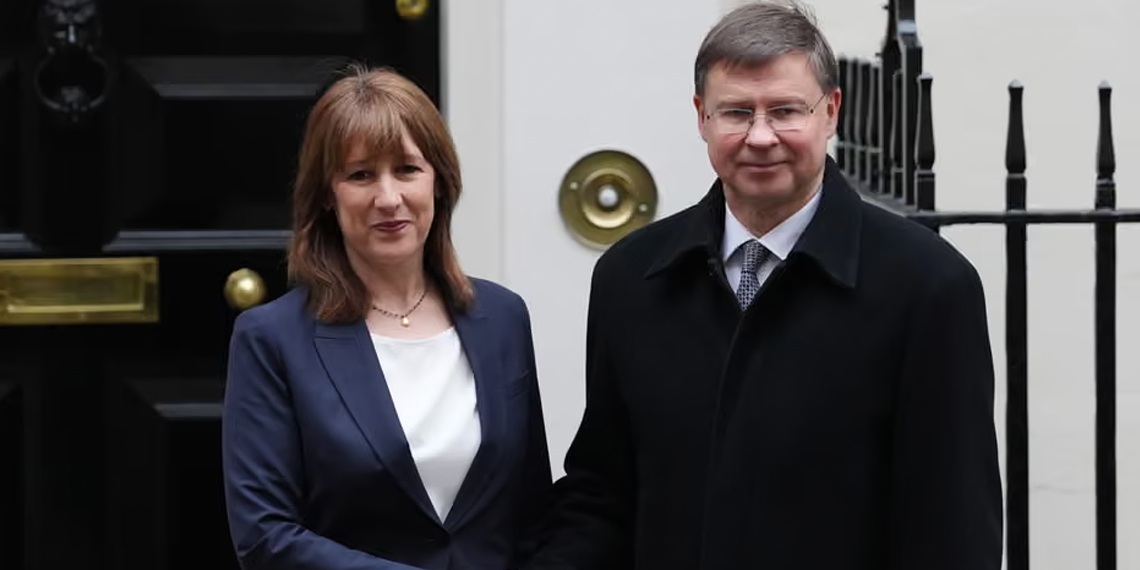
The European Commission has indicated it is open to discussing closer trade ties with Britain, including the possibility of a UK customs union, as Labour faces mounting pressure to reset post-Brexit relations in a bid to boost economic growth.
Valdis Dombrovskis, the EU’s economy commissioner, said Brussels was “ready to engage with an open mind” when asked whether the bloc would consider a customs union with the UK, signalling a noticeably warmer tone ahead of potential EU-UK negotiations.
Labour under pressure to deepen EU trade links
The comments come as the Labour government explores ways to improve trade flows with the EU amid weak growth, global instability and ongoing friction at UK borders since Brexit. Senior Labour figures have argued that reducing red tape and aligning more closely with the EU could provide a much-needed economic lift.
Prime Minister Sir Keir Starmer has said a full customs union “doesn’t now serve our purpose very well” but has also acknowledged that there may be “other areas in the single market” where closer cooperation could deliver benefits.
Customs union would reshape UK trade policy
A UK customs union with the EU would significantly alter Britain’s independent trade policy, potentially undermining existing post-Brexit trade deals with countries such as India, Australia and Japan. While these agreements carry political weight, economists widely agree they have delivered limited economic gains.
In contrast, a customs union would place the UK within the EU’s network of more than 40 trade agreements covering around 70 countries and regions, potentially easing trade frictions for British exporters.
EU warns against cherry-picking the single market
Dombrovskis cautioned that the UK would not be able to selectively align with parts of the EU single market. He said full participation remained the most “mutually beneficial” arrangement but reiterated that it requires acceptance of the four freedoms: free movement of goods, services, capital and people.
Since the 2016 Brexit referendum, the EU has consistently maintained that the four freedoms are indivisible. EU officials remain wary of offering bespoke arrangements to the UK that could prompt similar demands from member states.
Warmer political signals from Brussels
Despite these red lines, senior EU figures have adopted a more conciliatory public tone. European Parliament president Roberta Metsola said the UK and EU “need a new way of working together” across trade, customs, research, mobility, security and defence.
Speaking in Spain, Metsola urged both sides to “exorcise the ghosts of the past” and reset their partnership as Europe faces mounting geopolitical and economic challenges.
Talks already under way on key sectors
Negotiations are already progressing on several practical areas, including a veterinary agreement to reduce border checks on food exports, a youth mobility scheme, UK participation in the EU electricity market, and linking carbon emissions trading systems.
Cabinet Office minister Nick Thomas-Symonds said these deals could be worth £9bn a year to the UK economy by 2040, describing Labour’s approach as “ruthlessly pragmatic”. He reaffirmed, however, Labour’s manifesto commitment not to rejoin the single market or customs union or restore freedom of movement.
EU single market reform adds urgency
The renewed UK-EU dialogue comes as Brussels seeks to revitalise the single market following a stark 2024 report by former Italian prime minister Mario Draghi, which warned Europe risked becoming “subordinated, divided and deindustrialised”.
EU leaders are due to meet in Belgium next week for a special summit focused on strengthening the single market, described by European Council president António Costa as “a strategic imperative”.
As both sides confront slowing growth and global uncertainty, officials acknowledge that the direction of UK-EU trade relations will be a defining issue for Britain’s economic strategy in the years ahead.