
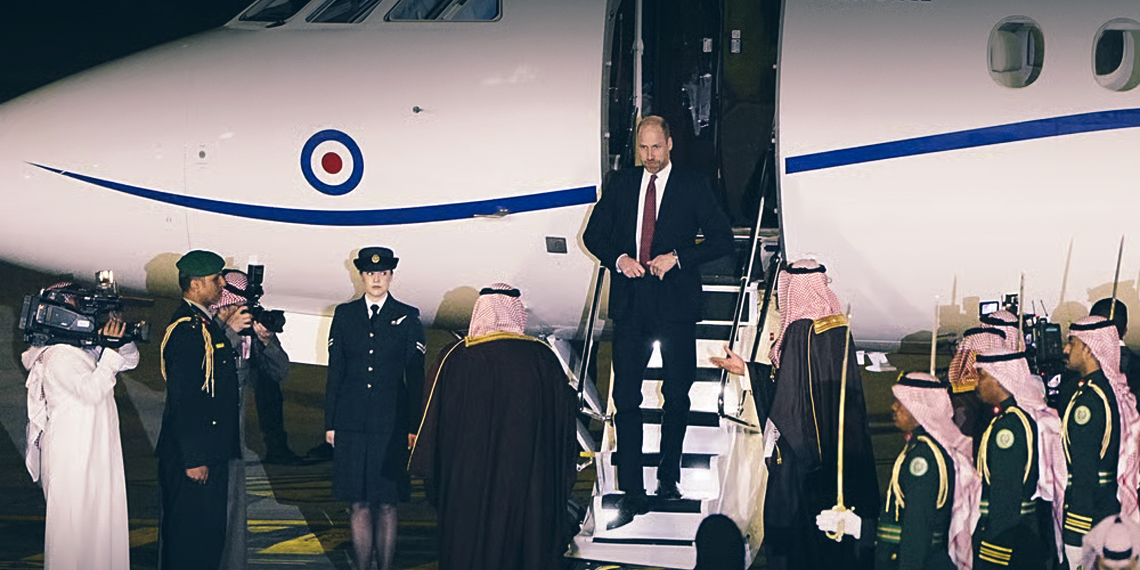
The Prince of Wales has arrived in Saudi Arabia for what aides describe as the most significant overseas visit of his public career, beginning a three-day trip centred on talks with Crown Prince Mohammed bin Salman.
Prince William travelled to the Gulf state at the request of the UK government, with the aim of strengthening relations between Britain and one of its closest Middle East allies, a country that plays a major political, religious and economic role in the region. The visit includes formal talks with the Saudi leader and a private dinner at the crown prince’s farm, located within a Unesco World Heritage Site near the capital, Riyadh.
UK and Saudi officials are hopeful the meetings will deepen a personal rapport between Prince William and Mohammed bin Salman, known as MBS. Any long-term relationship between the two is seen as potentially shaping Anglo-Saudi relations for decades, given William’s future role as king.
However, the visit comes amid continued controversy surrounding the Saudi leadership. The crown prince heads an absolute monarchy that has faced sustained criticism in the West over human rights, with his international reputation badly damaged after a US intelligence assessment concluded he had ordered the 2018 killing of journalist Jamal Khashoggi — an allegation denied by Saudi authorities.
A source said of the Saudi reception to the visit: “They are delighted that he’s here.
“The fact that he’s a prince and the future king matters enormously. They want it to be a friendship that lasts.”
Just hours before William’s arrival, Kensington Palace issued the first public statement from the Prince and Princess of Wales on the Jeffrey Epstein scandal, which has continued to surround the Duke of York. A spokesperson said: “I can confirm that the Prince and Princess of Wales have been deeply concerned by the continued revelations.
“Their thoughts remain focused on the victims.”
The statement was released shortly before William landed in Riyadh, amid a sense within the palace that it was important to clarify the couple’s position before the trip began. The issue intensified further after Thames Valley Police confirmed it was assessing claims that Andrew shared confidential documents during his time as a UK trade envoy.
Prince William arrived at King Khalid International Airport aboard an RAF aircraft and was greeted by Prince Mohammed bin Abdulrahman bin Abdulaziz, the deputy governor of Riyadh. Following a traditional welcome with gahwa — Arabic coffee flavoured with cardamom — and brief discussions with senior figures, he travelled to his first engagement with the crown prince.
The visit was discussed in advance with King Charles, who has made multiple public and private trips to Saudi Arabia, and William was also briefed by the UK’s ambassador to the kingdom, Stephen Hitchen.
William and the crown prince are scheduled to tour the Unesco-listed At-Turaif site in Diriyah, one of the world’s largest mud-brick settlements, before holding formal talks and a private dinner. Saudi officials say the crown prince prefers informality, with the evening expected to include a traditional meal shared around a fire with close family members. William will be accompanied by his private secretary, Ian Patrick, and the British ambassador.
It remains unclear whether human rights concerns will be raised during the discussions, though observers note that in Saudi political culture sensitive issues are often addressed privately rather than in public forums.
Felix Jakens, head of campaigns at Amnesty International, urged the prince to intervene in specific cases.
“We’ve asked Prince William to raise the case of British national Ahmed Al Doush, who was arrested visiting Saudi Arabia on holiday in 2024, and sentenced to 10 years in prison, as he understands over tweets from 2018,” he said.
“The ordeal Ahmed has had to endure has been harrowing, and toll on his wife and four children is unimaginable. Any influence Prince William is able to exert behind closed doors could be critical in securing his release.”
The crown prince is the architect of Saudi Arabia’s Vision 2030 programme, which aims to modernise the kingdom, diversify its economy and attract foreign investment. Reforms under the plan have included expanded rights for women, including the lifting of the ban on women driving in 2018.
Jakens cautioned that progress remained limited. “Saudi Arabia’s Vision 2030 has aimed in part to reposition the country as a tourist hotspot,” he said.
“But visitors should be aware that the country’s human rights record remains grim, with more people executed last year than Amnesty has ever recorded in a single year, and severe punishments for those deemed to be critical of the regime.”