
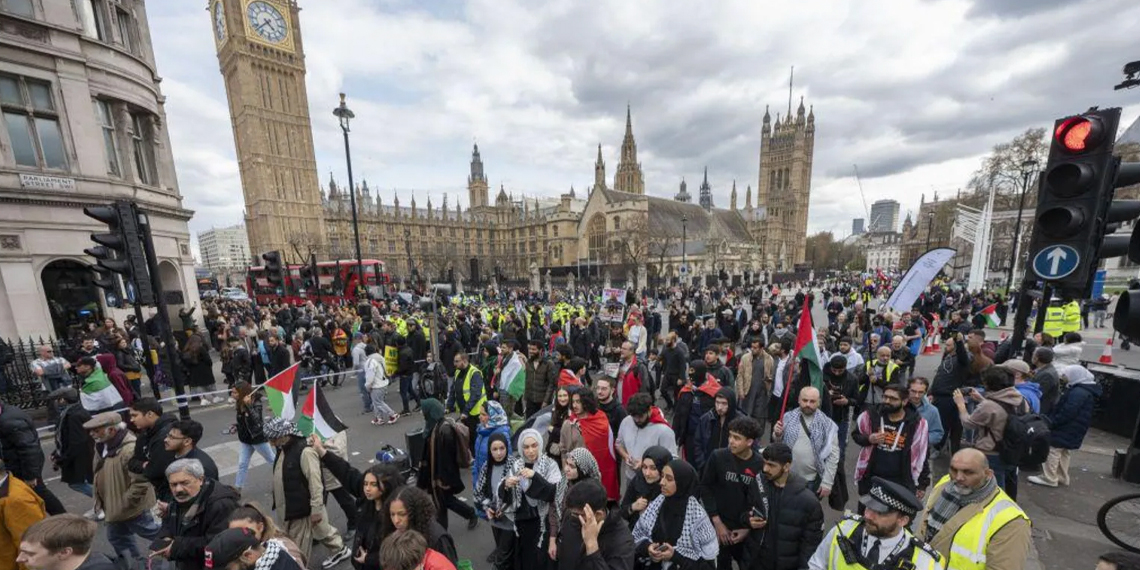
The Al Quds Day march ban London has been approved by the UK government after police warned that the demonstration could lead to serious public disorder due to escalating tensions linked to the conflict in the Middle East.
Home Secretary Shabana Mahmood confirmed that the Metropolitan Police requested the ban after assessing intelligence indicating a significant risk of clashes between protesters and counter-protesters.
The decision means the annual Al Quds Day march scheduled for Sunday will not be allowed to proceed as a moving demonstration in central London.
Authorities say the Al Quds Day march ban London was necessary because of the expected scale of the event and the likelihood of confrontations between opposing groups.
Police warn of risk of violence
The Metropolitan Police said it had asked the government to impose the ban after evaluating security risks related to the demonstration.
Officials cited concerns about large numbers of both protesters and counter-protesters gathering at the same time, which could lead to violence.
Police also raised concerns about the organisers’ political positions, stating that the event has historically been associated with groups supportive of the Iranian regime.
Metropolitan Police Commissioner Sir Mark Rowley said intelligence assessments suggested the situation posed a serious risk.
He explained that officers had concluded the potential for clashes between opposing groups meant allowing the march to proceed could result in public disorder.
Rare use of powers to prohibit marches
The Al Quds Day march ban London marks the first time a protest march has been banned in the capital since 2012.
Under UK law, police can request a ban on a march if they believe serious disorder cannot be prevented through standard restrictions.
However, such decisions require approval from the Home Secretary before they can take effect.
The Metropolitan Police emphasised that the decision was not taken lightly.
Sir Mark said the measure is rarely used and is only considered when multiple risk factors converge.
He noted that the last time such powers were used was more than a decade ago.
Ban applies to march and counter-protests
Police confirmed that the ban covers both the planned Al Quds Day march and any associated counter-protest marches.
The restriction came into force at 16:00 on Wednesday and will remain in place for one month.
While the march itself is prohibited, the law does not allow police or government officials to ban stationary demonstrations.
Instead, officers can impose strict conditions on static protests, including limits on location, duration and conduct.
Organisers say protest will continue
The Islamic Human Rights Commission (IHRC), which organises the annual Al Quds Day demonstration, criticised the decision to ban the march.
The group insists the event is a peaceful protest in support of Palestinian rights.
Organisers said they plan to hold a stationary protest instead of a march.
Faisal Bodi, representing the IHRC, described the decision as damaging to civil liberties.
He said the ban represents “a sad day for freedom of expression” and for the right to protest.
Government defends decision
Home Secretary Shabana Mahmood defended the Al Quds Day march ban London, stating that it was necessary to maintain public safety.
In a statement, she said the decision was made due to the scale of the protest and the likelihood of clashes between opposing groups.
Mahmood also stressed that while the right to protest remains protected, authorities must intervene when intelligence suggests serious public disorder could occur.
She added that law enforcement would apply strict conditions to any stationary protest that takes place.
Authorities have warned that anyone promoting hatred or inciting violence during demonstrations will face legal consequences.
Mayor of London supports police judgment
London Mayor Sir Sadiq Khan said the right to protest remains an important part of democratic life in the UK.
However, he acknowledged that the police had raised specific concerns about this particular event.
Khan said the decision to ban the march does not undermine broader freedoms but reflects the unique risks associated with the demonstration.
He added that the Metropolitan Police must follow evidence and intelligence when making public safety decisions.
Debate over freedom of protest
The Al Quds Day march ban London has sparked debate about the balance between public safety and the right to protest.
Former Metropolitan Police Chief Superintendent Dal Babu described the decision as extremely serious but said it would have been based on detailed intelligence assessments.
Babu noted that police typically impose restrictions on protests rather than banning them entirely.
He said an outright prohibition is “extremely unusual” and therefore likely reflects significant security concerns.
Government officials have also emphasised that peaceful protest remains protected under UK law.
Chief Secretary to the Prime Minister Darren Jones said people are free to demonstrate on any issue as long as protests remain legal and peaceful.
Controversy surrounding Al Quds Day demonstrations
Al Quds Day demonstrations have taken place annually for decades in several countries.
The event was first established shortly after the 1979 Iranian Revolution and is held on the last Friday of Ramadan.
The day is named after the Arabic name for Jerusalem.
Large demonstrations are organised in Iran and other parts of the world, including the UK.
Supporters describe the event as an international protest in solidarity with Palestinians and others facing oppression.
Critics argue that some marches have included expressions of support for groups considered extremist or hostile to Israel.
Previous arrests during London marches
Authorities say previous Al Quds Day marches in London have resulted in arrests.
Police reported that some participants in earlier demonstrations had been detained for offences including support for banned organisations and antisemitic hate crimes.
During last year’s event, hundreds of people joined the march through central London.
Counter-protests were also organised by pro-Israel groups.
Police maintained a separation between the two groups to prevent clashes.
One person was arrested during the event for an alleged offence under the Public Order Act.
The Metropolitan Police also reported that 10 individuals were arrested during the 2024 demonstration.
Growing tensions since Israel-Hamas conflict
Calls to prohibit the march increased after the Hamas-led attacks on Israel on 7 October 2023.
The resulting war in Gaza and heightened tensions across the Middle East have led to more polarised protests in many countries.
British authorities have been under pressure to prevent demonstrations that could escalate into violence or promote extremist rhetoric.
The Al Quds Day march ban London reflects these broader concerns about security and public order during a period of heightened geopolitical tension.
As the stationary protest moves forward under police conditions, the debate over protest rights, public safety and political expression in the UK is likely to continue.