
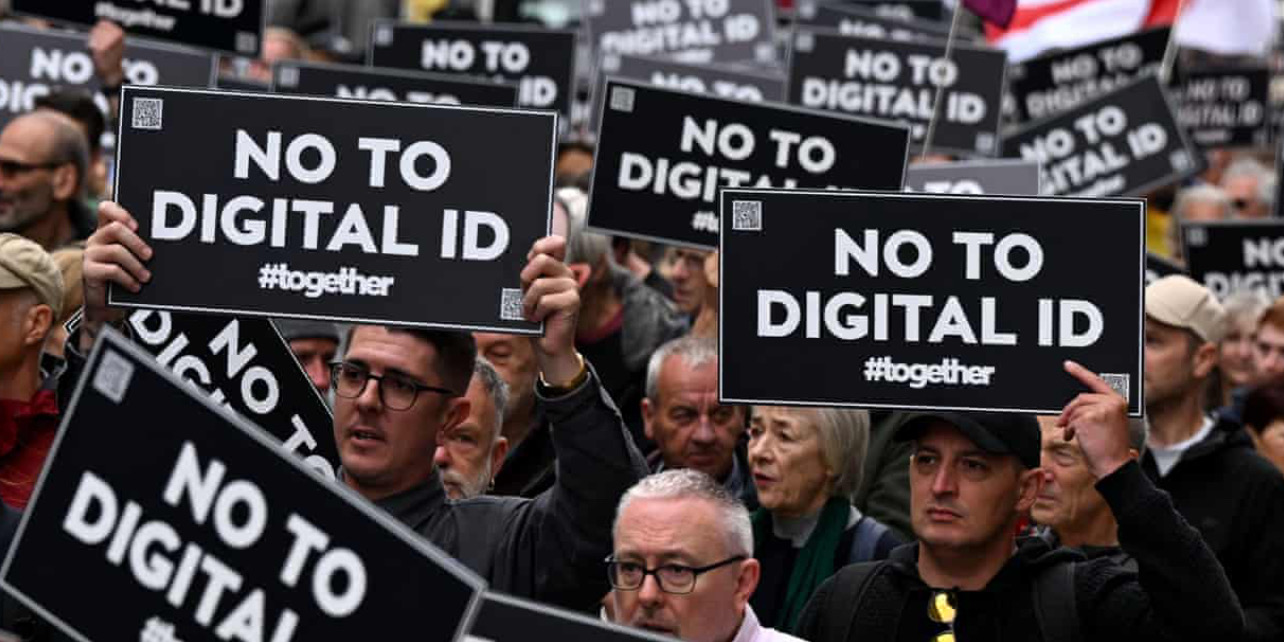
Incoming Prime Minister Andy Burnham is expected to abandon Keir Starmer’s proposed digital ID card scheme as one of his first major policy decisions, redirecting funding towards tackling the cost of living.
The move, expected after Burnham enters Downing Street on Monday, is being presented by his team as part of a wider “reset of priorities” aimed at distancing the new Labour leader from controversial policies introduced under his predecessor.
The proposed digital ID scheme faced strong public opposition after it was unveiled last year, with a petition against the plans attracting around three million signatures.
A spokesperson for Burnham said: “One of the first things this government will do is put its focus where people need it right now: creating breathing space and delivering change they can feel in their everyday lives.”
“That means all the time and resource that was going to be spent on a national ID scheme will go instead to where it’s most needed, such as helping with the cost of living.”
The spokesperson added: “This government is determined to bring power back to communities, instead of hoarding it in Whitehall. We will work every day to lift this country back up to where it belongs – with growth in every postcode, and hope in every heart.”
It remains unclear how much money will be saved by cancelling the scheme, as the previous government never published a definitive budget. The Office for Budget Responsibility estimated the project could cost around £1.8 billion, although officials disputed that figure.
Starmer first announced the digital ID proposal last September as part of plans to combat illegal working. The “Brit card” was due to be introduced by 2029 and would have contained a holder’s residency status, name, date of birth, nationality and photograph.
At the time, Starmer described the programme as “an enormous opportunity for the UK”, saying the cards “will make it tougher to work illegally in this country, making our borders more secure”.
Digital identity cards have long divided opinion in British politics. Legislation introduced by Tony Blair’s Labour government in 2006 was later repealed by the coalition government before the cards were ever introduced.
Supporters of the scheme argued it would modernise public services. Alexander Iosad, Director of Government Innovation at the Tony Blair Institute, said: “Make no mistake, if the government announces a universal digital ID to help improve our public services, it would be one of the most important steps taken by this or any government to make British citizens’ everyday lives easier and build trust.”
However, the proposals also attracted strong criticism from opposition parties and privacy campaigners.
Conservative MP David Davis warned: “No system is immune to failure, and we have seen time and again governments and tech giants fail to protect people’s personal data. If world-leading companies cannot protect our data, I have little faith that Whitehall would be able to do better.”
The Liberal Democrats also opposed compulsory digital IDs, while Open Rights Group Director Jim Killock warned the policy risked creating “a digital surveillance infrastructure that will change everyone’s daily lives and establish a pre-crime state where we constantly have to prove who we are”.
Following the backlash, the previous government had already watered down the plans, confirming earlier this year that digital IDs would be voluntary and that workers could continue proving their right to work using existing documents such as passports.
Despite dropping the digital ID proposal, sources close to Burnham said he remains committed to cracking down on illegal working. Right-to-work checks are expected to remain compulsory, with new legislation likely to extend verification requirements to gig economy workers, including delivery drivers and parcel couriers.
Liberal Democrat Cabinet Office spokesperson Lisa Smart welcomed the reported decision.
“People will be hugely relieved to know they are no longer set to be forced to hand over their data just to go about their daily lives.”
She added: “We have long said the obscene sums earmarked for digital ID would be a huge waste of taxpayers’ money, and it’s a relief that Burnham has woken up to that.”
The decision is also expected to fuel concerns within the technology sector, as Burnham is reportedly considering wider Whitehall reforms that could see the Department for Science, Innovation and Technology merged into a larger business department.