
The Strait of Hormuz shipping attacks have intensified after multiple vessels were struck by projectiles near Iran’s coast, raising concerns about the safety of one of the world’s most important maritime trade routes.
According to the United Kingdom Maritime Trade Operations (UKMTO), three separate incidents involving commercial vessels were reported on Wednesday in or near the Strait of Hormuz, a critical passage connecting the Persian Gulf with global shipping lanes.
The latest Strait of Hormuz shipping attacks come amid escalating tensions in the region following military strikes involving Iran, the United States and Israel, which have triggered disruptions to maritime traffic and global energy markets.
Vessel struck in Strait of Hormuz forces crew evacuation
The UKMTO reported that one vessel was struck by a projectile approximately 11 nautical miles north of Oman while sailing through the Strait of Hormuz.
The strike caused a fire onboard the vessel and forced crew members to evacuate.
Authorities did not initially disclose the identity of the ship involved in the incident.
Emergency response teams and maritime authorities began monitoring the situation as investigations into the attack continued.
Additional incidents reported near UAE waters
Two additional attacks were reported earlier on Wednesday in waters near the United Arab Emirates.
One vessel was hit by a projectile roughly 50 nautical miles northwest of Dubai.
Another ship was damaged in a separate incident off the coast of the UAE.
The UKMTO said authorities are still gathering information about the attacks and urged ships operating in the region to exercise extreme caution.
Maritime operators were also advised to report any suspicious activity to regional security authorities.
Thailand-flagged vessel targeted during transit
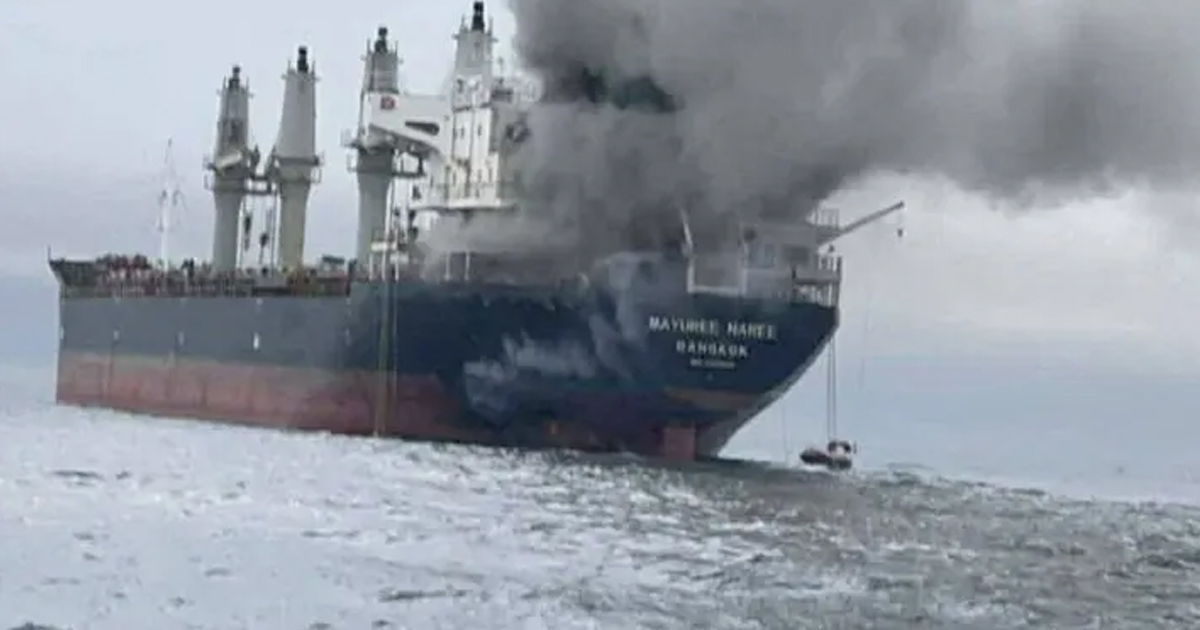
Thailand’s navy confirmed that a Thailand-flagged container ship named Mayuree Naree, carrying 23 people onboard, was attacked while passing through the Strait of Hormuz.
Images circulated online showed thick black smoke rising from the vessel following the attack.
Reports indicated that the ship suffered damage during the incident, though no immediate casualties were confirmed.
Later statements from Iran’s Islamic Revolutionary Guard Corps suggested that Iranian forces had fired on the vessel while it was navigating the strategic waterway.
The claim was reported by the semi-official Tasnim news agency and cited by Reuters.
Maritime traffic slows dramatically in key shipping route
The latest Strait of Hormuz shipping attacks have significantly disrupted maritime traffic in the region.
Shipping activity in the narrow waterway has slowed to near standstill levels since late February, when the United States and Israel launched airstrikes on Iran.
In response, Iranian forces have targeted vessels attempting to transit the strait, according to multiple reports.
The resulting security risks have forced many shipping companies to halt operations or reroute vessels to avoid the region.
Strait of Hormuz critical to global energy supply
The Strait of Hormuz is widely regarded as one of the most strategically important maritime corridors in the world.
The narrow passage connects the Persian Gulf to the Gulf of Oman and provides access to global shipping lanes in the Arabian Sea and beyond.
Approximately 20% of the world’s oil and natural gas supplies typically pass through the strait each day.
Because of this concentration of energy exports, any disruption to shipping in the region can quickly affect global energy prices and supply chains.
Analysts warn that sustained disruptions could have serious consequences for international trade and energy markets.
U.S. naval operations target Iranian vessels
The shipping incidents occurred shortly after U.S. forces conducted military operations near the Strait of Hormuz.
U.S. Central Command reported that American naval forces had sunk several Iranian vessels near the waterway.
According to the statement, the operation targeted 16 Iranian minelayer ships suspected of preparing to deploy naval mines in the strait.
Naval mines are considered a major threat to commercial shipping because they can block maritime routes and damage vessels.
Trump calls for removal of potential naval mines
U.S. President Donald Trump previously warned that any mines placed in the Strait of Hormuz must be removed immediately.
His statement followed intelligence reports suggesting Iran might attempt to mine the waterway in retaliation for military strikes.
The United States has increased its naval presence in the region as tensions continue to escalate.
Military officials say protecting shipping lanes in the Gulf remains a top priority.
Maritime security alerts issued
The UKMTO has issued repeated warnings to ships operating in the Persian Gulf and nearby waters.
Between February 28 and March 11, the maritime monitoring centre received 17 reports of incidents affecting vessels in the region.
These reports included 13 confirmed attacks and four cases of suspicious activity.
The incidents occurred across several areas, including the Persian Gulf, the Strait of Hormuz and the Gulf of Oman.
Authorities continue to monitor the situation and coordinate with international naval forces operating in the region.
Analysts warn of threat to global supply chains
Security analysts say the ongoing Strait of Hormuz shipping attacks could have far-reaching consequences for global trade.
Torbjorn Soltvedt, principal Middle East analyst at risk intelligence company Verisk Maplecroft, warned that the disruption could severely affect international supply chains.
He said Iran’s retaliatory actions against maritime traffic and regional infrastructure have effectively cut off a critical artery for global commerce.
According to Soltvedt, the flow of oil, liquefied natural gas, refined fuels and chemical shipments through the strait has slowed dramatically.
Rising risks for commercial shipping
Experts warn that shipping companies now face increased risks when operating in or near the Strait of Hormuz.
The latest incidents demonstrate that the threat to commercial vessels remains significant as regional tensions continue.
Soltvedt said additional overnight attacks highlight that Iran still poses a serious danger to shipping traffic in the area.
Insurance costs for vessels operating in the Gulf have also begun rising sharply, reflecting the increased risk of attacks.
History of tensions in the Strait of Hormuz
The Strait of Hormuz shipping attacks are the latest episode in a long history of geopolitical tensions affecting the region.
Because the strait is so vital to global energy supplies, it has frequently been at the centre of military confrontations and diplomatic disputes.
Past conflicts involving Iran, Gulf states and Western powers have occasionally led to threats to close the waterway or disrupt shipping.
Such actions can have immediate effects on global oil prices and international trade.
With military tensions currently escalating in the Middle East, the safety of the Strait of Hormuz has once again become a major concern for governments, shipping companies and energy markets worldwide.